
Wearable Counter-Drone Systems: What U.S. Army Trials Reveal About Soldier Protection.
U.S. Army exercises are bringing drone detection and disruption closer to the individual soldier. Official reporting shows how wearable equipment fits into a broader effort to protect troops—and why warning alone is only the beginning.
How much protection against a drone can a soldier carry on a tactical vest?
Army records document wearable counter-drone equipment in exercises in Germany in 2025 and further assessments in Mississippi in 2026. Together, these activities offer a useful view of how personal warning devices are being evaluated alongside other defenses. www.dvidshub.net
1. Bringing Drone Warning to the Soldier
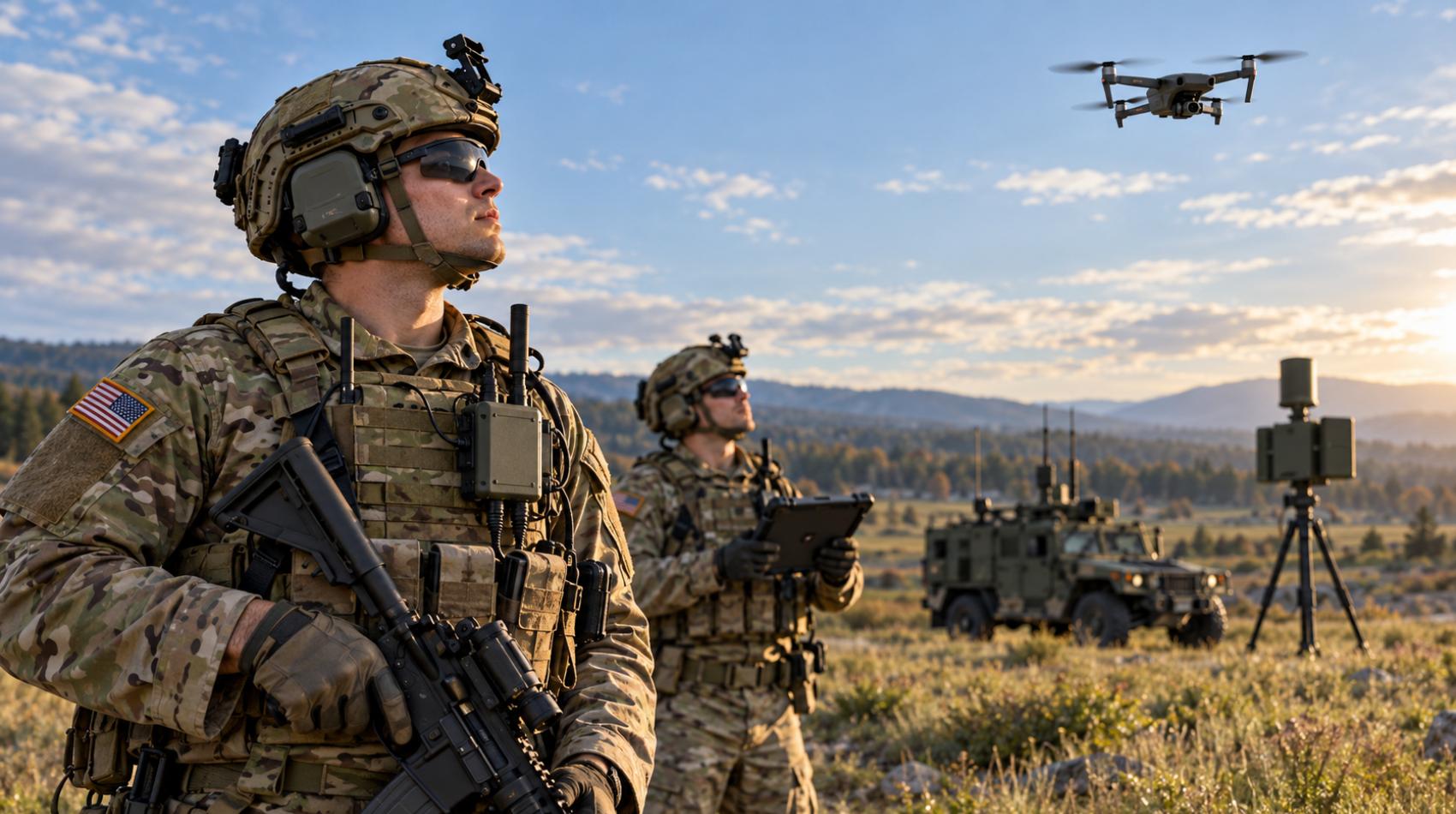
On June 7, 2025, soldiers from 3rd Squadron, 2nd Cavalry Regiment mounted Wingman and Pitbull devices on their tactical vests during Project Flytrap at Hohenfels, Germany.
The official U.S. Army photo record on DVIDS describes Wingman as a detector that alerts the wearer to nearby unmanned aircraft threats. The soldier can then activate the Pitbull radio-frequency jammer when a drone is within range. www.dvidshub.net
The distinction between these functions is central to understanding the technology. Detection provides warning. Disruption attempts to interfere with the drone. Receiving an alert does not establish that the threat has been neutralized.
From a protection perspective, the practical question is whether that warning gives the wearer useful information in time to respond.
2. From Detection to a Decision
Further evaluation took place during Operation Sentinel Justice 26 at Camp Shelby, Mississippi.
In its June 17, 2026 account of the exercise, the Army identifies Wingman as a MyDefence wearable RF detector and Pitbull as an RF disruption tool. Emerging technologies were placed into training scenarios so soldiers could use them and provide feedback.
The Army organized its assessment around three functions: detect, decide and defeat. Its report also describes AirScout, Dronebuster 4 and SMASH among the systems evaluated. www.army.mil
For the individual soldier, the implication is straightforward: a device must fit into a usable response process. An alert needs to be understood, the situation assessed and an appropriate action selected. Equipment design and training therefore belong in the same discussion.
3. Why Wearable Systems Need a Wider Defense
Project Flytrap expanded beyond individual equipment. The Army’s May 18, 2026 report on Flytrap 5.0 describes counter-drone integration at squadron level in Lithuania.
U.S. and British participants tested more than 50 industry-provided technologies, including radars, RF defeat systems and kinetic interceptors. Systems were networked across a combined tactical data architecture and tested against a live opposing force. www.army.mil
This suggests that evaluating a wearable device in isolation provides only part of the picture. The surrounding formation also needs to share information and coordinate its response.
For readers exploring the wider technology landscape, HLS.today’s industry profiles of Vorpal and D-Fend Solutions offer related reading. These profiles are background resources, rather than evidence of participation in the Army exercises discussed here.
4. What the Trials Tell Procurement Teams
The official accounts establish that soldiers used and evaluated the equipment. They do not provide a comprehensive public dataset showing the wearable systems’ detection probability, false-alarm rates or defeat success across different threats. www.dvidshub.net
That leaves practical questions for anyone assessing a purchase:
- How reliably does the system detect the threats relevant to the mission?
- Can operators interpret alerts while carrying out other duties?
- How do battery endurance and equipment weight affect sustained use?
- How well does the device work with the unit’s other protective systems?
These are evaluation priorities, not failures demonstrated by the reports. Their purpose is to connect technical specifications with the conditions in which people actually depend on the equipment.
5. The Connection to Homeland Security
The emphasis on usability also appears in HLS.today’s coverage of DHS counter-drone testing for state and local law enforcement.
That assessment examined practical demands such as transporting, setting up and operating equipment during realistic scenarios. Although policing and military missions differ, the shared procurement question is clear: can the intended users put the capability to work when needed? hls.today
For soldiers, wearable counter-drone systems offer a way to carry warning and response tools with them. The Army’s exercises show why those tools must be assessed alongside training, decision-making and wider defenses. Their ultimate value rests on how consistently they help turn an alert into effective protection.