
FAA Ground Stop – America strengthened airport security after 9/11. The latest nationwide flight disruption highlights another essential layer of protection: keeping the networks behind the skies reliable, secure and recoverable.
By HLS.Today | November 15, 2026
For passengers, the first sign of trouble is often a departure board that stops moving.
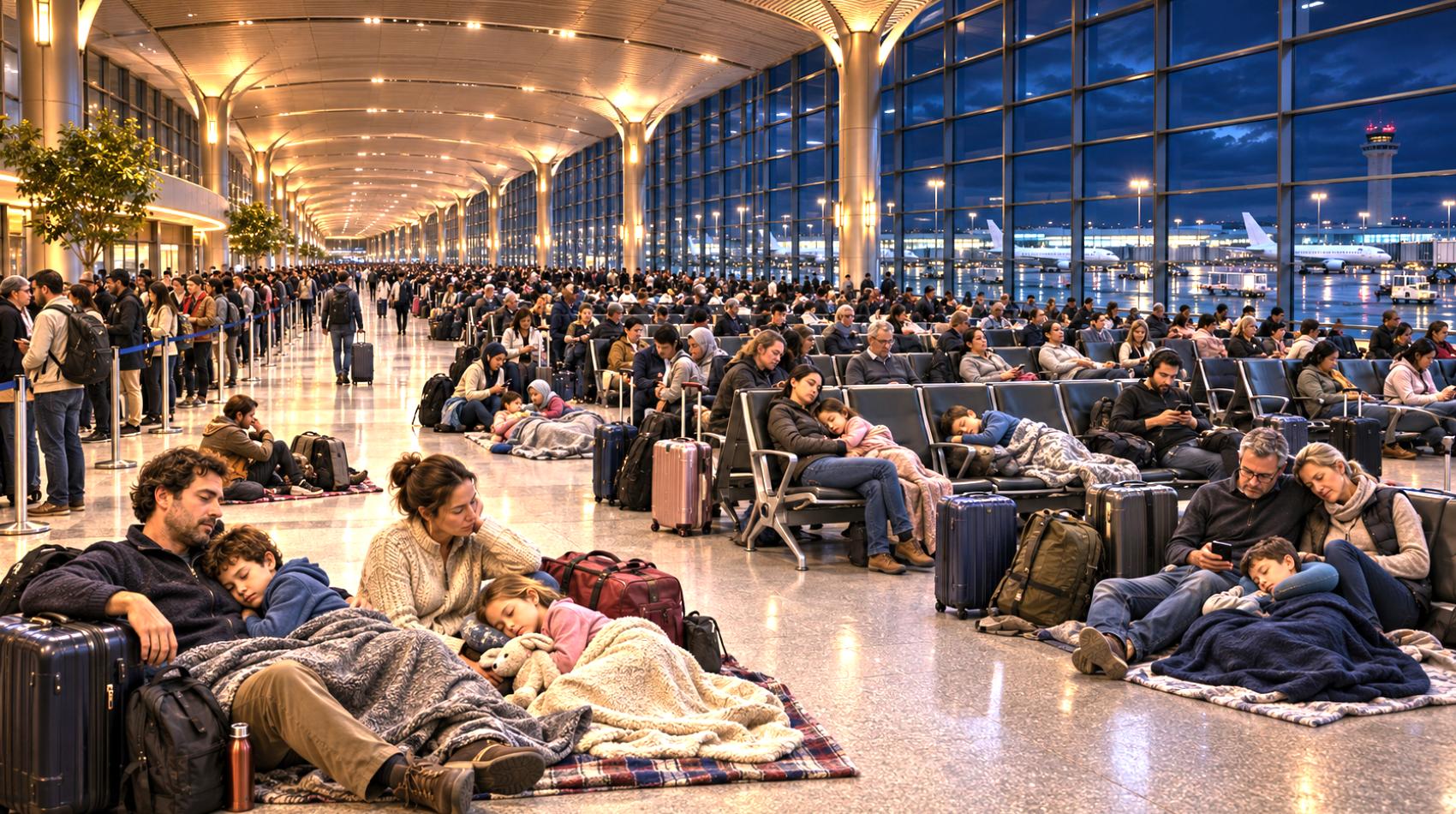
Behind the terminal windows, aircraft wait. Inside, travellers refresh their phones, crews await instructions and connecting flights become increasingly uncertain. Somewhere beyond the airport, a technical problem has become a national disruption.
That was the challenge facing U.S. aviation on November 13, when the Federal Aviation Administration announced a nationwide ground stop after communications problems affected multiple air traffic control centres. The agency described its initial information as preliminary. Federal Aviation Administration
The incident raises a question that extends beyond delayed flights: how resilient is the infrastructure that keeps America’s aircraft moving safely?
The official explanation points to a telecommunications malfunction during maintenance not a confirmed attack. Yet the disruption offers a timely reminder that homeland security also depends on systems that can withstand mistakes, equipment failures and deliberate interference.
What Happened and Why Flights Were Stopped
In its November 14 update, the Department of Transportation described work at a remote FAA location to replace an aging copper telecommunications connection with fibre.
According to Transportation Secretary Sean Duffy’s preliminary account, a router involved in the change began generating excessive connection attempts, affecting other routers and disrupting communications and radar feeds.
Officials were still determining whether the underlying problem involved installation error or faulty equipment. The ground stop was a precaution taken after the instability appeared, rather than a scheduled nationwide closure for an upgrade.
Duffy also addressed speculation about a cyberattack:
“we don’t believe this was cyber at all.”
DOT said systems recovered after the problematic work was isolated. Its November 14 update confirmed that the airspace had reopened, although passengers could still face delays and cancellations. www.transportation.gov
The Network Passengers Never See
Most travellers associate aviation technology with the aircraft: engines, navigation displays and cockpit instruments.
But a flight also depends on infrastructure on the ground. Controllers need dependable communications and surveillance information as aircraft move between airport towers, terminal facilities and en-route control centres.
In its November 13 briefing summary, DOT explained that the incident involved intermittent instability rather than the complete loss of all radar and telecommunications. Duffy said newer IP switches remained operational while older equipment was affected.
The department reported reopening the airspace at 8:15 p.m. Eastern Time that evening. It also explained why restarting departures would take longer: aircraft might be available while pilots, flight attendants or other operational resources were not. www.transportation.gov
That is what makes aviation disruption so difficult to contain. Restoring a technical service and restoring an airline schedule are two different jobs.
After 9/11, America Changed How It Protected Flying
The September 11 attacks forced a fundamental reassessment of aviation security.
The response brought changes passengers could see: federal screening personnel, more extensive baggage checks and stronger protection against unauthorized access to aircraft cockpits.
A 2003 Government Accountability Office review documented the creation of the Transportation Security Administration in November 2001, the deployment of a large screening and security workforce, and major progress in screening checked baggage for explosives. It also identified longstanding vulnerabilities involving airport access and air traffic control computer systems and facilities.
The FAA’s historical account of the post-9/11 period records requirements for reinforced cockpit doors, expanded security checks and the transfer of TSA into the newly established Department of Homeland Security in March 2003.
Those measures responded to a demonstrated terrorist threat. The November 2026 outage has a different reported cause.
The useful historical connection is the need to reassess protection as vulnerabilities become clearer. Aviation security includes the passenger checkpoint, the cockpit door and the infrastructure supporting every flight.
Readers can explore more of this wider picture in HLS.Today’s airport-security coverage.
A Warning America Has Heard Before
The latest disruption is not the first reminder that a maintenance problem can have nationwide consequences.
Following the January 2023 outage of the Notice to Air Missions system, the FAA’s preliminary review found that contract personnel had unintentionally deleted files while attempting to correct synchronization between a primary database and its backup.
The agency said it had found no evidence of a cyberattack or malicious intent and had taken steps to improve the system’s resilience. Federal Aviation Administration
The two incidents involve different systems and circumstances. Together, however, they illustrate why upgrading equipment is only part of the challenge.
The transition itself must be dependable. Changes need to be tested, problems contained and recovery procedures ready before a local fault can interrupt a national service.
The Security Threats are Real, Even When an Outage is Accidental
There is a separate, documented security concern behind this discussion.
In its September 2026 report, Aviation Cybersecurity: Enhanced Air Safety Requires FAA to Better Mitigate Threats to Aircraft Communications, GAO identified gaps in assessing and responding to threats such as jamming and spoofing.
Put simply, jamming interferes with a signal, while spoofing introduces false information that may appear legitimate.
GAO found incomplete risk assessments and security documentation, gaps in real-time monitoring capabilities, and weaknesses involving authentication and protection of certain aviation communications. It issued nine recommendations, with which DOT agreed. files.gao.gov
These findings do not establish a connection to the November ground stop. They explain why aviation communications deserve attention beyond routine maintenance.
The question for security planners is whether the system can continue operating safely or recover predictably when information becomes unavailable or unreliable.
Airspace protection also faces other challenges, including unauthorized drones. HLS.Today’s reporting on DHS counter-drone testing for state and local law enforcement examines another part of that protective effort, distinct from the telecommunications failure discussed here.
Modernization Is Already Underway
The FAA’s Brand New Air Traffic Control System initiative aims to replace outdated infrastructure, including telecommunications networks, radar, software and hardware, with an implementation goal of the end of 2028.
There are concrete signs of progress. A separate September 2026 GAO review of modernization reported that, as of May, FAA had replaced 2,560 of 5,170 aging copper connections with fibre-optic communications cables.
However, the review also identified the need for stronger cost and schedule planning.
For passengers, the measure of success will be straightforward: fewer disruptions and dependable service.
For homeland-security professionals, the test goes further. New infrastructure must be secure, maintainable and able to contain failures. Progress should be judged by demonstrated reliability as well as installation milestones.
What a Stronger System Should Deliver
The incident makes several practical questions worth following:
- Can a problem at one location be contained before it affects other facilities?
- Are replacement components tested under realistic operating conditions?
- Can backup systems remain usable when the primary system encounters trouble?
- Can operators distinguish malicious interference from technical failure quickly?
- Are recovery procedures rehearsed across agencies, contractors and airlines?
These are questions for future findings and oversight, rather than conclusions about what failed on November 13.
They also show why an outage belongs in HLS.Today’s broader homeland-security coverage: protecting essential services requires both preventing attacks and limiting the consequences of disruption from any cause.
Protecting the Journey Behind the Checkpoint
After 9/11, reinforced cockpit doors and expanded screening became visible symbols of a new security era.
The infrastructure now demanding attention is less visible: communications links, network equipment, surveillance feeds and the procedures used to change them safely.
The November ground stop should not be turned into an unsupported terrorism narrative. Its significance is compelling enough without one.
Aviation security depends on trustworthy information and on the ability to recover safely when that information stops flowing.
For the travelling public, the next major security improvement may be something they never notice: a fault that stays local, a backup that works and a flight that departs safely on time.