
Haiti at a Turning Point – An ambush involving four Salvadoran personnel has triggered a major deployment, renewed American warnings to Haiti’s gangs and fresh questions about how international assistance can deliver lasting security under Haitian authority.
HLS.Today | November 7, 2026
Reporting period: October 18–November 7, 2026.
Haiti’s security crisis has entered a new phase. Following an October 18 attack that left four Salvadoran aviation technicians missing, El Salvador rapidly expanded its military presence. On November 7, the U.S. Embassy warned of ongoing security operations in its vicinity in Tabarre, with heavy gunfire reported nearby. The latest warning underscores the continuing risks as Haitian authorities and international partners seek to restore security and government control.
The central question is whether these reinforcements can produce sustained protection for civilians and restore government authority. Official statements show determination, but they also expose unresolved issues involving command arrangements, the duration of El Salvador’s deployment and the political transition that security operations are intended to support.
The public record does not yet establish that Haiti has reached a decisive security breakthrough. It does establish a substantial escalation in international involvement.
Three Weeks That Changed El Salvador’s Role
On October 18, an armored vehicle carrying Salvadoran personnel came under attack in Croix-des-Bouquets, near Port-au-Prince. Salvadoran military statements, reported by the Associated Press, said four aviation technicians escaped the burning vehicle but could not subsequently be located.
On October 21, President Nayib Bukele announced a military operation to recover them. El Salvador initially presented the action as a rescue mission, with the possibility of a stronger response if the personnel were not returned safely.
By October 27, Reuters reported approximately 1,000 Salvadoran troops had arrived, citing a security official. Its subsequent reporting placed the contingent at around 2,000 by October 28. Those figures describe successive stages of the buildup and should not be treated as contradictory estimates taken at the same moment.
A November 4 statement from El Salvador’s Ministry of Foreign Affairs confirms the continuing search mission and diplomatic coordination with Haiti. Foreign Minister Alexandra Hill thanked her Haitian counterpart, Raina Forbin, for support for the Salvadoran deployment.
The ministry also reproduced Bukele’s message that the immediate objective was to bring the four technicians home, while describing pressure against gangs harming Haitian communities.
As of this review, the sources examined did not establish a verified recovery of the four personnel. Claims about their fate should therefore remain attributed rather than presented as confirmed.
What the Recent U.S. Embassy Alert Says
The latest embassy security alert located during this review is dated November 2, 2026.
Reporting that links to the original alert describes ongoing security operations near Tabarre and Croix-des-Bouquets, instructions for U.S. government personnel to avoid the area and advice to monitor local information.
Verification note: The embassy’s original page blocked direct retrieval. These details are therefore attributed to the published account of the alert, rather than presented as a directly verified embassy quotation.
Separately, the State Department’s directly accessible travel advisory continues to classify Haiti as Level 4: Do Not Travel, citing crime, kidnapping, terrorism, unrest and limited healthcare. It warns that security restrictions severely limit the U.S. government’s ability to provide emergency assistance.
The distinction matters: a localized embassy security alert provides immediate safety information. It does not, by itself, announce American combat operations, an evacuation or a change in the international mission’s mandate.
Who Is Operating in Haiti?
Several institutions are involved, and their roles should not be merged into a single “UN force.”
| Actor | Role established in the reviewed sources |
|---|---|
| Haitian authorities and security forces | Retain primary responsibility for national security and civilian protection. |
| Gang Suppression Force—GSF | Security Council-authorized multinational force supporting efforts against gangs. |
| UN Support Office in Haiti—UNSOH | Provides logistical and operational support to the GSF within its mandate. |
| UN Integrated Office in Haiti—BINUH | Supports political, institutional and related stabilization work. |
| Additional Salvadoran contingent | Deployed following the October 18 ambush; its relationship with existing mission structures requires careful distinction. |
On September 29, the Security Council renewed the GSF mandate through March 31, 2027. The UN’s announcement explicitly emphasized Haitian authorities’ primary responsibility for security and civilian protection.
The most important clarification came during the October 30 UN spokesperson’s briefing: the vast majority of the additional Salvadoran personnel fell outside the scope of UNSOH’s support mandate.
That does not, by itself, establish that the deployment is unlawful. It does mean that the additional troops cannot automatically be counted as personnel operating under the same support and oversight arrangements as the GSF.
What U.S. Officials Have Actually Said About the Outcome
At the Security Council on October 19, U.S. Ambassador Mike Waltz expressed support for El Salvador and warned that the ambush would not intimidate the international coalition into retreat.
He backed the GSF’s effort to confront gangs, remove barriers to normal life and support the restoration of Haitian institutions. But he also acknowledged uncertainty:
“There is no guarantee it will work.”
His remarks linked security operations with economic opportunity and preparations for credible elections. Washington’s stated objective therefore extends beyond defeating armed groups in individual engagements: it includes helping create conditions in which Haitian institutions can function.
A separate U.S. statement at the Security Council on October 14, just before this article’s three-week reporting window, supported sanctions, measures against illicit arms flows and Haiti’s disarmament, dismantlement and reintegration initiative.
This provides useful policy context: the American approach publicly described at the UN combines security pressure with efforts to reduce the networks and incentives sustaining gang activity.
Reuters also reported that U.S. C-130 aircraft helped transport Salvadoran troops, citing an American military official. That is evidence of reported logistical assistance, not confirmation of a new American ground-combat mission.
Haiti’s Position: Assistance Under National Authority
Prime Minister Alix Didier Fils-Aimé has publicly emphasized that foreign forces are present to support the Haitian state, rather than replace it.
According to the Associated Press’s November 3 reporting, the government is presenting security restoration and elections as linked priorities while asserting its leadership of the security effort.
The Salvadoran Foreign Ministry’s November 4 account provides direct government-source confirmation of ongoing bilateral cooperation. It records Haiti’s support for the search deployment and communication between the two governments.
On November 5, Fils-Aimé met members of the diplomatic corps. A Primature statement reported by Le Nouvelliste identified security, elections, internal displacement and migration among the subjects discussed.
The distinction between political authorization and operational coordination remains important. Expressions of governmental support do not answer every public question about command responsibilities, detention arrangements or how different forces coordinate their activities.
Why the Crisis Cannot Be Explained by the Latest Ambush Alone
The October escalation sits within a much longer institutional and security crisis.
Gang influence expanded following President Jovenel Moïse’s assassination in 2021. Haiti subsequently sought international security assistance as violence weakened public institutions and repeatedly disrupted electoral plans.
The UN’s October 19 assessment describes gangs adapting to intensified operations through hostage-taking, intimidation and reprisals against civilians, while extending violence beyond the capital.
It reported 1,123 people killed and 440 injured between July and early October, alongside nearly 1.5 million internally displaced people. These figures concern the broader crisis; they are not casualties attributable to El Salvador’s recent deployment.
The same assessment warned that security operations themselves had caused casualties, including among people not associated with gangs. Civilian protection is therefore a measure of whether stabilization is succeeding—not an issue separate from it.
More Troops Are Arriving, but Sustaining Them Matters
In her October 19 Security Council briefing, UNSOH head Daniela Kroslak said the GSF had roughly doubled from the just-over-1,000 personnel present when she briefed in July.
She anticipated further deployments through the end of 2026, while identifying practical requirements involving screening, equipment readiness, transportation and logistical support.
Those statements describe the GSF’s expansion. They should not be combined indiscriminately with the additional Salvadoran rescue contingent to produce a single supposedly verified force total.
For HLS.Today’s security reporting, this is a familiar distinction: personnel numbers indicate potential capacity, while operational effectiveness depends on coordination, sustainment and the ability to protect people after an operation ends.
Elections Remain a Central Test
Haiti’s Provisional Electoral Council—CEP— issued an updated electoral-calendar announcement dated October 28.
The official notice says the revision followed changes to the electoral framework and consultations with security forces, political actors, civil society, business representatives and the government. It reaffirms the objective of inclusive, credible and transparent elections.
Associated Press reporting on the revised schedule gives July 18 and October 4, 2027, as the planned election rounds. Those are scheduled milestones, not guarantees that security conditions will permit voting.
UN officials have warned that lasting stabilization requires more than retaking territory. Their stated priorities include sustained state presence, political progress and disarmament and reintegration, particularly for children associated with gangs.
What Could Happen Next?
The following possibilities are editorial analysis based on official statements and reported developments, rather than predictions attributed to the U.S. government.
A more clearly defined Salvadoran mission. On November 6, Vice President Félix Ulloa told EFE that Fils-Aimé was expected in El Salvador on November 16–17, when the governments would discuss the contingent’s future. That meeting could clarify duration and objectives, but no outcome should be assumed in advance.
Security gains that support Haitian institutions. This is consistent with the goals expressed by Washington, Haiti and the UN: suppress gang violence while enabling public services, economic activity and elections.
Continued fighting with civilian reprisals. The UN’s account of gangs adapting to pressure shows why stronger deployments do not necessarily produce an immediate reduction in violence.
Disarmament contacts without a comprehensive settlement. In a November 7 report, AP said the 400 Mawozo gang had contacted Haiti’s disarmament commission. A commission representative confirmed an approach on the group’s behalf while stressing the government’s roadmap. Contact alone does not establish surrender, a ceasefire or an agreed political settlement.
The most meaningful indicators will be the verified fate of the missing Salvadorans, clearer mission arrangements, reduced civilian harm, sustained access to essential services and measurable progress toward Haitian-led governance.
The past three weeks have brought a stronger international response. Whether that response becomes lasting security remains an open question—one that U.S. officials themselves have acknowledged.
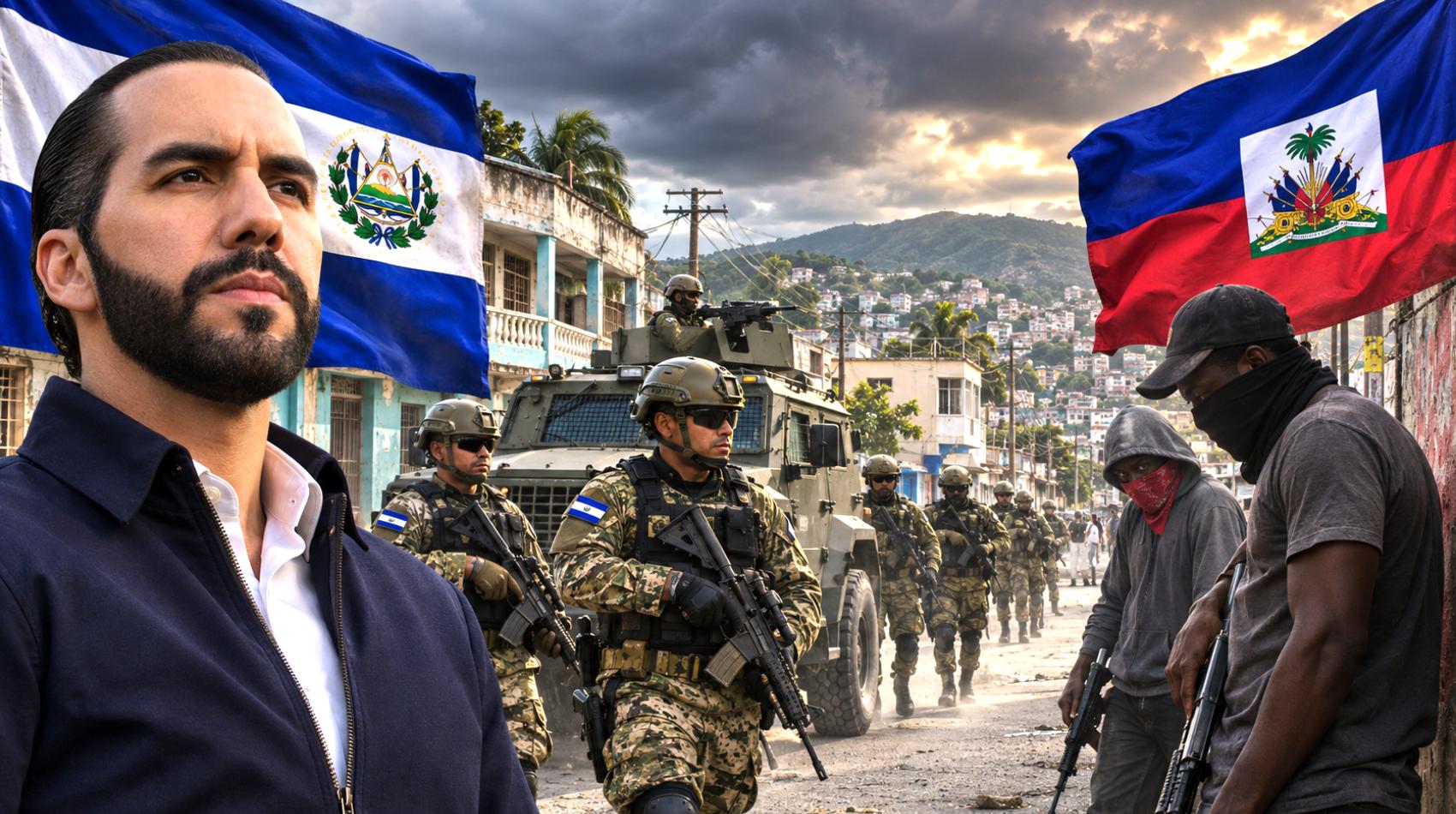
AI-generated featured image depicting Nayib Bukele, Salvadoran troops and fictional gang figures; not a photograph of an actual event.
Official sources and supporting references
- U.S. Embassy Haiti November 2 security alert
- U.S. Department of State Haiti travel advisory
- UN-hosted transcript October 19 Security Council meeting, including U.S. and Haitian statements
- UN-hosted transcript October 30 briefing on the additional Salvadoran troops
- UNSOH October 19 briefing on force expansion and support
- UNSOH Renewal of the GSF and support-office mandates
- UN October 19 assessment of security and political conditions
- Haiti’s Provisional Electoral Council Updated electoral-calendar announcement
- Reuters Salvadoran deployment and reported U.S. transport assistance
- Associated Press Haiti’s prime minister on foreign forces and state authority
- Associated Press November 7 disarmament contact