
AUSA 2026: Modern Warfare Is Redefining Defense and Homeland Security
Washington, D.C.
The Association of the United States Army’s AUSA Annual Meeting & Exposition 2026, taking place from October 12–14 at the Walter E. Washington Convention Center in Washington, D.C., arrives at an unusually consequential moment for the global defense and homeland security community.
Under this year’s theme, “America’s Army: The Foundation of the Joint Force,” more than 40,000 participants, over 750 exhibits and representatives from more than 100 countries are expected to take part in what has become North America’s leading land-power exhibition and one of the world’s most influential meetings between military leadership and the defense industry.

But AUSA 2026 is taking place against a very different strategic background from that of only a few years ago.
The war in Ukraine, this year’s major military operations involving Iran, rapidly changing security conditions in the Middle East, growing strategic competition in the Indo-Pacific and the proliferation of inexpensive drones, precision weapons and artificial intelligence have fundamentally changed the discussion surrounding military modernization.
The question facing the defense industry today is no longer simply what technology can be developed, but rather what can be produced quickly, affordably and in sufficient numbers to survive a prolonged, high-intensity conflict.
From Ukraine to Washington: Battlefield Lessons Arrive at AUSA
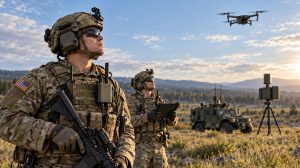
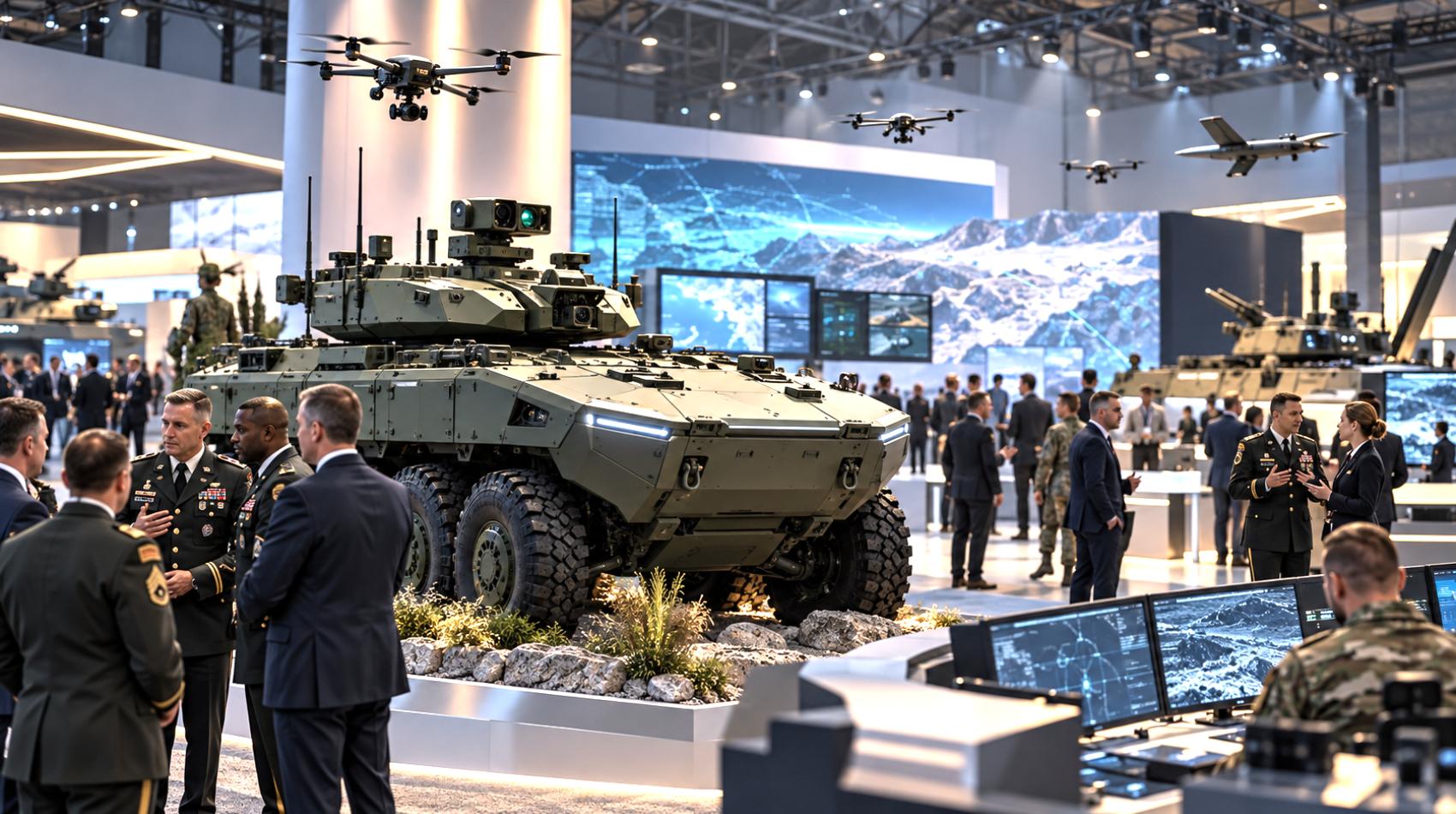
Walking through the AUSA exhibition halls this year, one of the most visible trends is the extraordinary presence of unmanned systems and counter-UAS technologies.
That is not accidental.
U.S. Army Under Secretary Michael Obadal described a “noticeable shift in warfare,” highlighting the extraordinary demand for both sophisticated munitions and inexpensive systems. Ukraine in particular has demonstrated how relatively low-cost drones can conduct reconnaissance, deliver precision effects, disrupt logistics and force much more expensive defensive systems to respond.
The economics of warfare have consequently become part of the technology discussion.
A sophisticated interceptor costing millions of dollars cannot always be the answer to an unmanned aircraft costing a fraction of that amount. The requirement is increasingly for layered detection, electronic warfare, inexpensive interceptors, directed-energy systems and scalable kinetic solutions.
This shift is clearly reflected throughout AUSA.
General Dynamics Land Systems is displaying new counter-drone capabilities alongside its Wolf XM30 candidate for the U.S. Army’s Bradley replacement program. Among the systems being presented are PERCH 2.0, M-SHORAD Increment 4 and the F600 Leonidas, combining the traditional requirements of armored maneuver with the emerging requirement to survive in an environment saturated with drones.
Northrop Grumman is presenting developments associated with its DRAKE electronic-warfare counter-UAS system, which uses operational feedback to continually update its software and configuration as drone threats change.
Israel Aerospace Industries used AUSA to unveil three new air-defense capabilities addressing evolving unmanned threats, including the Point@Air aerostat radar, a counter-drone interceptor and the Fire Storm 250, developed with SIG Sauer and combining a drone platform with a machine-gun payload.
Twenty-Six Defense, formerly Elbit Systems of America, meanwhile introduced Primex, a soldier-worn digital system combining low-light sensing, thermal imagery, augmented-reality capabilities and real-time processing.
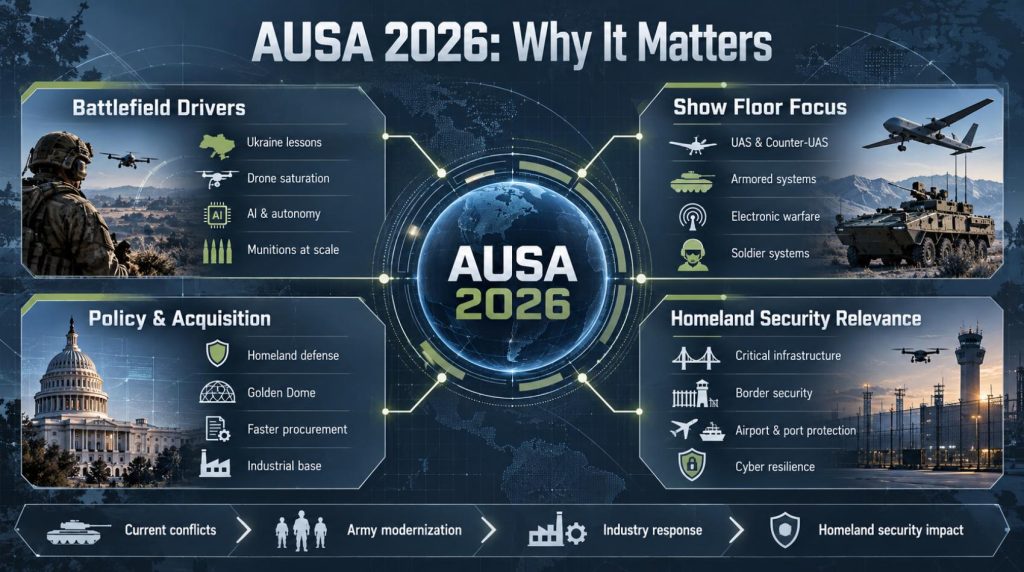
Across the exhibition floor, the common denominator is increasingly evident: sensors, software, AI, electronic warfare, autonomy and effectors are being brought together rather than treated as independent systems.
Ukraine Has Its Own Place at AUSA
Perhaps one of the strongest indications of how closely operational experience and defense innovation have become linked is the new Ukrainian Defense Tech Pavilion, part of AUSA’s outdoor exhibition area.
Seventeen Ukrainian defense technology companies are participating alongside military personnel with direct combat experience.
The program addresses subjects including the economics of mass military production, electronic warfare, integrated counter-drone ecosystems and emerging drone doctrine.
Participating organizations include Ukrspecsystems, Kvertus, Reactive Drones, Stellarion, Tencore, Phantom Defense, Osiris AI and the Third Army Corps of Ukraine, among others.
This is significant.
For decades, military exhibitions largely followed a model in which governments established long-term requirements, major defense companies developed solutions and armies eventually received the resulting equipment.
Ukraine has helped demonstrate another model: technology is deployed, tested against a real adversary, modified according to battlefield experience and returned to the field—sometimes within weeks rather than years.
Electronic warfare techniques change. Drone frequencies change. Navigation systems change. Countermeasures appear. Software is updated.
Modern warfare has therefore become an accelerating technological competition in which the ability to adapt can be almost as important as the initial performance of a system.
The U.S. Army Moves Toward Autonomy
That transformation is now becoming institutional.
During AUSA 2026, Acting Army Chief of Staff Gen. Christopher LaNeve announced the redesignation of the Army’s Futures and Concepts Command as the Army Futures and Autonomous Systems Command – FASCOM.
According to LaNeve, autonomous and unmanned capabilities are to be introduced across Army formations and warfighting functions, accompanied by new military specialties in UAS and robotics.
The development moves autonomy beyond experimentation.
Recent Army exercises have already tested combinations of autonomous vehicles, drone swarms, robotic breaching systems, mine detection and counter-UAS technologies, while maintaining human authorization for critical weapons decisions.
AI is following the same trajectory.
At AUSA, discussions on AI at the Edge are examining applications ranging from maintenance and battlefield management to autonomous systems and rapid distribution of targeting information.
The emphasis is increasingly on giving commanders and individual soldiers access to information and decision-support capabilities at the point where they are required—without depending entirely on centralized processing.
From the Battlefield to Homeland Security
These developments have implications reaching far beyond conventional land warfare.
The distinction between military defense and homeland security is becoming increasingly narrow.
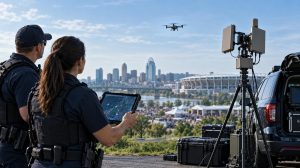
Small drones can threaten military installations, airports, energy facilities, government buildings, borders, public events and critical infrastructure.
Cyberattacks can target both military networks and civilian infrastructure.
Commercial satellite communications, AI, robotics, autonomous navigation and inexpensive sensors can be used by armed forces, security agencies—or hostile non-state actors.
One of the AUSA discussions this year, appropriately titled “Stopping the Swarm,” focuses directly on this challenge. The premise is that large numbers of inexpensive autonomous drones could overwhelm conventional defenses designed to engage individual targets, making layered sensing, artificial intelligence and scalable countermeasures increasingly important for both military forces and homeland protection.
This convergence is also reflected in the U.S. 2026 National Defense Strategy, which places defense of the American homeland among the Department of War’s primary missions and specifically identifies counter-UAS capabilities, cyber defense and the Golden Dome for America missile-defense initiative as priorities.
Washington Sends a Message to the Defense Industry
AUSA 2026 also takes place during a significant change in the relationship between Washington and its defense industrial base.
The current administration’s “Peace Through Strength” policy increasingly links military deterrence with industrial capacity.
The message from Washington is straightforward: technological superiority is insufficient if equipment cannot be manufactured quickly enough or in sufficient quantities.
A January 2026 Executive Order on defense contracting stated that while the United States produces some of the world’s most advanced military equipment, it does not produce enough of it quickly enough to meet the requirements of U.S. forces and allies. The order calls for accelerated procurement and a revitalized American defense industrial base.
Secretary of War Pete Hegseth’s Acquisition Transformation System follows the same philosophy: reduce bureaucracy, increase competition, bring commercial and non-traditional companies into the defense ecosystem and shorten the time between identifying an operational need and delivering capability to the warfighter.
In July, the Department of War suspended Phase II implementation of the Cybersecurity Maturity Model Certification while reviewing the program, explicitly citing the need to maintain cybersecurity while reducing barriers that could prevent smaller and non-traditional companies from entering the defense supply chain.
The administration describes the objective as rebuilding America’s “Arsenal of Freedom.”
That expression is particularly relevant at AUSA.
Modern military power increasingly depends not only on a handful of large prime contractors, but upon a broad ecosystem involving software developers, AI companies, robotics startups, electronics manufacturers, communications specialists, sensor companies and advanced manufacturing businesses.
A New Definition of Military Readiness
The implications are significant for defense manufacturers worldwide.
The priorities now visible at AUSA include:
- drones and autonomous systems;
- counter-UAS and layered air defense;
- artificial intelligence and battlefield software;
- electronic warfare and resilient communications;
- sensors and multi-domain situational awareness;
- robotic ground systems;
- precision and loitering munitions;
- rapid manufacturing and scalable production;
- open architectures allowing systems to evolve rapidly;
- resilient logistics, energy and infrastructure.
Even established platforms such as armored vehicles are increasingly being judged according to their ability to connect with drones, sensors, digital command networks and autonomous systems.
The platform itself is becoming part of a larger system of systems.
AUSA 2026 Reflects a World That Has Already Changed
AUSA has traditionally provided an indication of where the U.S. Army intends to go next.
AUSA 2026 is somewhat different.
Many of the technologies receiving the greatest attention—drones, electronic warfare, inexpensive precision weapons, AI, autonomous systems and counter-UAS—are not predictions about a distant battlefield.
They are responses to capabilities already being used.
The Army and the defense industry are therefore being asked to move at a pace much closer to that of the commercial technology sector while simultaneously preparing for wars in which industrial capacity, supply-chain resilience and the ability to replace equipment rapidly may again determine strategic outcomes.
For homeland security agencies, the same transformation has important consequences. Technologies developed to protect soldiers and military installations from drones, cyberattacks and autonomous threats will increasingly become relevant to borders, airports, ports, energy infrastructure and major population centers.
And for the global defense industry, Washington’s message appears equally clear.
The next competitive advantage will not necessarily belong only to the company offering the most sophisticated system.
It may belong to the company capable of learning faster, integrating faster and producing at scale.
That is perhaps the most important message emerging from AUSA 2026.
The future battlefield is no longer waiting to arrive. Much of it is already here.