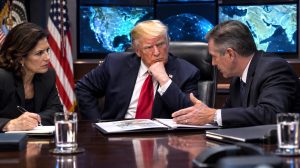

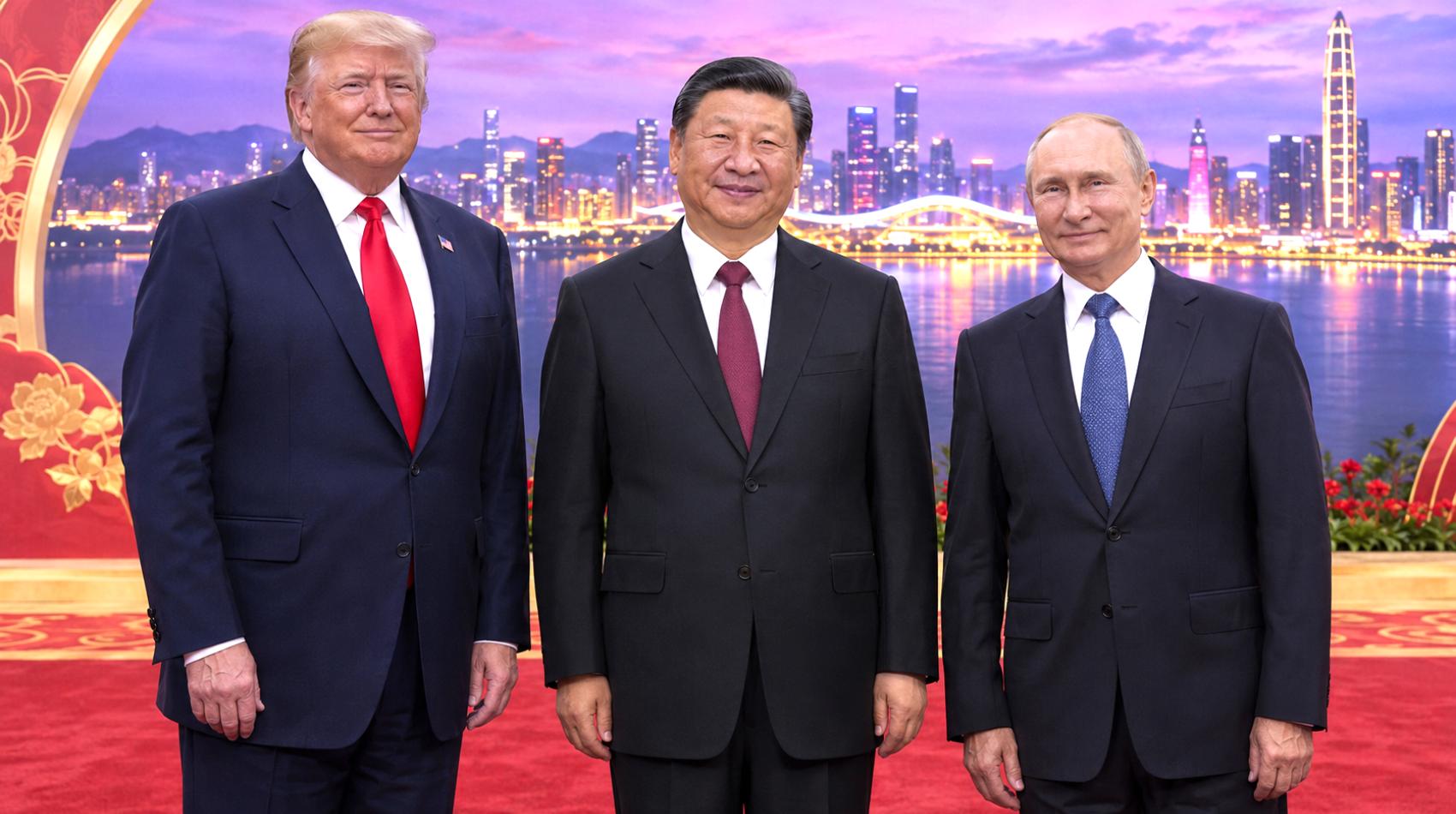
Historic Trump, Xi and Putin China Meeting – The Shenzhen summit produced a joint declaration on nuclear risk and energy security. Separate talks addressed Ukraine and U.S.–China cooperation but the published announcements stop short of a peace settlement or a three-country trade agreement.
HLS.Today | November 19, 2026
Three presidents, three competing world powers and a diplomatic agenda with consequences far beyond the meeting room.
President Donald Trump, Chinese President Xi Jinping and Russian President Vladimir Putin met in Shenzhen on November 19, bringing direct engagement between Washington, Beijing and Moscow into the spotlight. China’s government confirmed the trilateral summit, held alongside the Asia-Pacific Economic Cooperation gathering. english.www.gov.cn
The meeting offers a possible opening for cooperation at a moment when military confrontation, energy security and economic competition are closely intertwined. Its significance, however, depends on what follows: diplomatic language must become specific commitments before it changes conditions on the ground.
The clearest outcome is a four-point declaration. Published by the White House and China’s Foreign Ministry, the document identifies common ground on United Nations reform, increased production and supply of refined petroleum products, state officials’ immunities and nuclear-risk reduction.
Its most consequential security statement is direct:
“a nuclear war cannot be won and must never be fought.”
The leaders committed to dialogue on reducing nuclear risks and preventing proliferation. The declaration contains no numerical weapons limits, inspection arrangements or disarmament timetable. Its energy language likewise provides no production volumes or implementation dates.
It also does not announce a Ukraine ceasefire or a comprehensive trilateral trade agreement. The document establishes shared intentions; it leaves the practical work ahead. The White House
Ukraine was discussed in the separate meetings. According to remarks published by the Russian Foreign Ministry’s official channel, Putin said he had discussed Ukraine with Xi the previous day and devoted much of his November 19 bilateral meeting with Trump to the issue.
Putin stated:
“Today, at President Trump’s initiative, we devoted much of our bilateral meeting to the issue.”
The ministry also confirmed that Secretary of State Marco Rubio and Treasury Secretary Scott Bessent attended the Trump–Putin meeting. Russia’s participants included Foreign Minister Sergey Lavrov, Finance Minister Anton Siluanov, presidential aide Yuri Ushakov and investment envoy Kirill Dmitriev.
This establishes substantive diplomatic contact involving senior security and economic officials. The composition of a delegation, however, does not establish that sanctions relief, investment commitments or territorial arrangements were agreed. Putin’s account is an official Russian description of the discussions, rather than a jointly published account of their outcome. Telegram
Kyiv’s position remains essential to any assessment of peace prospects. In his November 18 address, Ukrainian President Volodymyr Zelenskyy said American envoys had promised to brief Ukraine in Berlin on Trump’s discussions, including those in China.
He also described preparations for additional defense and energy support and consultations with European partners. His statement was issued before the Shenzhen summit concluded, so it should be read as Ukraine’s position entering this stage of diplomacy, not as a response to the final declaration. president.gov.ua
Two days earlier, Zelenskyy had described negotiations involving Ukrainian, American and European teams, stating:
“We need a dignified end to the war and guaranteed security for Ukraine.”
That official Ukrainian account identifies a wider negotiating process involving major European governments, EU representatives and NATO. president.gov.ua
The potential benefit of Shenzhen is therefore an opening for further negotiations. Direct exchanges could help clarify positions or give negotiating teams new instructions. Those are possible outcomes, not announced results. A durable settlement would still require answers on security guarantees, implementation and the participation of the countries directly affected.
The most detailed trade-related announcement concerns Washington and Beijing. In its official account of the Trump–Xi meeting, China said the leaders agreed to formulate an action plan for a constructive relationship of strategic stability.
The Chinese readout attributes to Trump an interest in strengthening cooperation in agricultural products, energy and “super intelligence.” It also describes discussion of fentanyl cooperation, repatriation of people without legal immigration status, and efforts against telecommunications and cyber fraud.
Xi called for better communication on economic concerns and cooperation to manage AI security risks. The readout says the two sides should ensure that AI remains under human control.
These are meaningful areas for follow-up, but the source is China’s account of the meeting. It does not provide a jointly signed commercial package, purchase values, tariff schedules or a detailed technology agreement. tz.china-embassy.gov.cn
For businesses, that distinction is practical. A promise to improve relations can encourage planning, but companies need published rules, contracts and implementation dates before treating political discussions as changes to their operating environment.
A three-way economic opening is possible, but its shape remains undefined. The subjects raised suggest several areas where interests could overlap: reliable energy supplies, agricultural commerce and reduced disruption to international trade.
That is an assessment of the diplomatic opening, not evidence of an undisclosed bargain. The public documents reviewed do not establish that the three governments negotiated a common market, a free-trade zone or a coordinated package exchanging commercial concessions for progress in Ukraine.
The next evidence to watch is concrete: ministerial negotiations, signed agreements, published purchase commitments and formally announced policy changes. Those developments would show whether the summit’s economic language is becoming operational.
For HLS.Today readers, the relevance extends beyond diplomacy. Energy availability affects transport and essential services. Cooperation against cross-border fraud and narcotics concerns public safety directly. Nuclear-risk discussions address the possibility of escalation between major powers.
These connections also run through HLS.Today’s reporting on maritime security and U.S.–Iran tensions around Hormuz and documented Iranian-linked threats to the United States. Dialogue between governments can create opportunities for cooperation while security agencies continue addressing specific threats.
Shenzhen has opened another channel for high-level diplomacy. Whether it produces lasting progress will become clearer when negotiators return with measures that can be implemented and verified—and, for Ukraine, when diplomacy delivers an agreement that changes the course of the war.
Based on official material available on November 19, 2026. Statements from individual governments are attributed to those governments; possible outcomes are identified as analysis.