

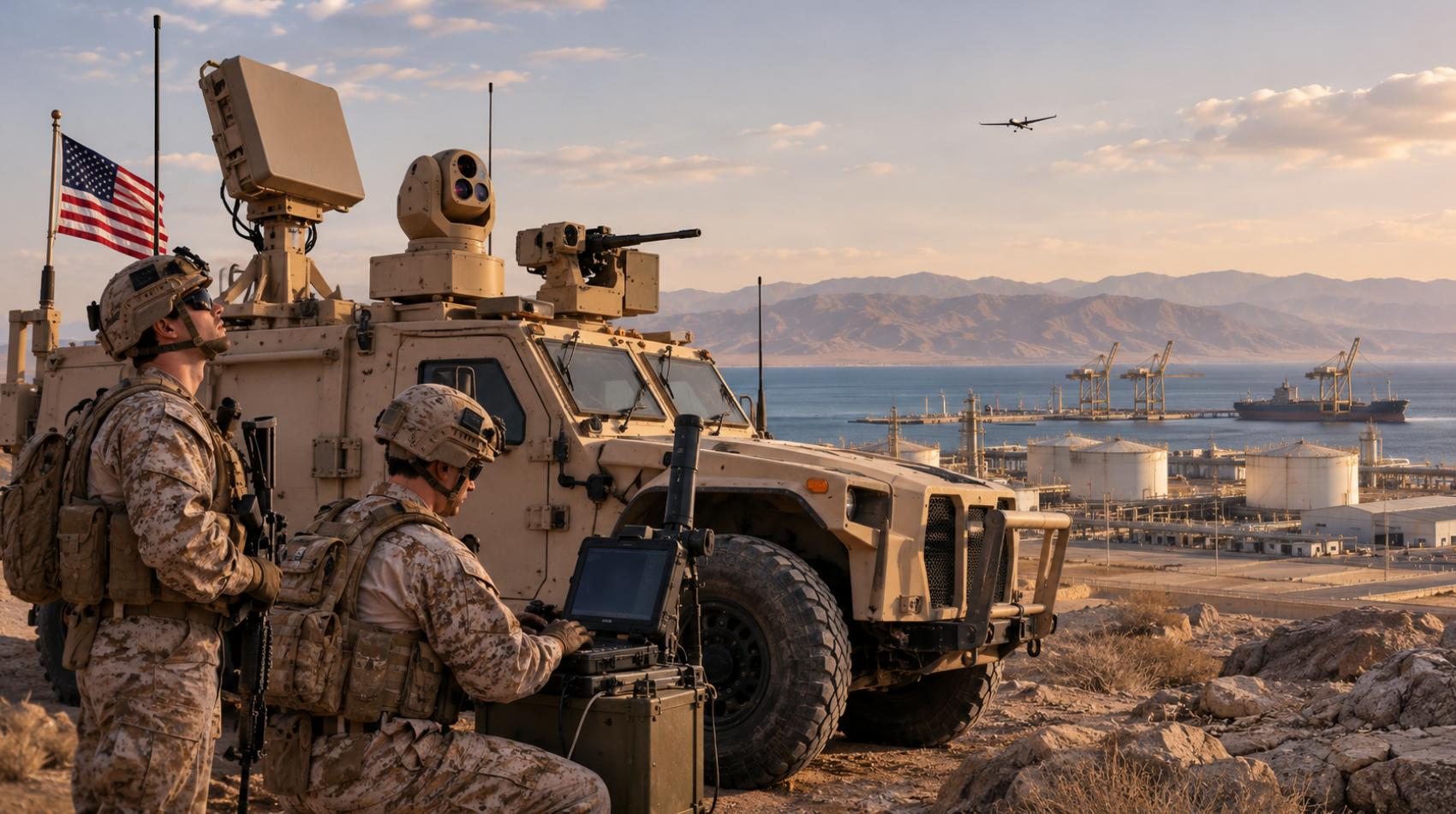
Detect, Track, Defeat – From Marine radar vehicles and Coyote interceptors to electronic warfare, lasers and microwave weapons, official U.S. sources reveal how drone defense is evolving—and which capabilities are actually documented in the Middle East.
HLS.Today | November 3, 2026
Protecting troops and critical infrastructure from hostile drones begins well before an interceptor launches. Defenders must detect a small airborne object, maintain its track, determine whether it poses a threat and select an appropriate response—all while managing friendly aircraft and other activity overhead.
The confrontation with Iran has made that challenge more urgent. But descriptions of an American “counter-drone shield” can obscure an important reality: there is no single system that protects every base, ship or allied facility.
Official U.S. records instead describe a combination of sensors, command networks and weapons. Some are documented in the Middle East. Others have been demonstrated with regional partners, proposed for export or selected for further testing.
An October 27 U.S. Army article captured the approach. Col. Tony Lindh, rapid acquisition chief for Joint Interagency Task Force 401, stated:
“There is no silver bullet technology that will solve the drone problem.”
The task force emphasizes integrated defenses supported by trained personnel, compatible equipment and clear operating authorities.
For HLS.Today, the essential questions are therefore practical: What detects the drone? What defeats it? And what evidence establishes that the equipment is actually in use?
1. What Is Publicly Confirmed in the Iran Conflict?
CENTCOM’s April 6, 2026, Operation Epic Fury fact sheet lists counter-drone systems among the American assets employed. It separately identifies Patriot and THAAD missile-defense systems.
That establishes the presence of counter-drone capabilities within the operation, but the fact sheet does not identify every model, its location or its engagement record. Nor should Patriot, THAAD and dedicated small-drone defenses be treated as interchangeable equipment.
More specific official evidence identifies two important capabilities:
- Marine LMADIS equipment: Marine Corps photographs document the 11th Marine Expeditionary Unit setting up a Light Marine Air Defense Integrated System sensor in the CENTCOM area on September 4, 2026.
- Merops interceptors: A March 26 Army publication states that thousands of Merops interceptors were deployed to the Middle East to help defend American forces and regional partners against Iranian drones.
These records confirm regional presence or deployment. They do not provide a comprehensive, independently verified account of interceptions.
2. Detection Comes First: The Sensors Behind the Shield
A counter-drone installation typically combines several technologies because each contributes different information.
| Technology | What it contributes | Documented example |
|---|---|---|
| Radar | Detects airborne objects and maintains tracks | KuRFS within LIDS; radar within MADIS |
| Electro-optical and infrared cameras | Help operators visually identify and follow a detected object | LIDS and Marine air-defense systems |
| Passive radio-frequency sensing | Detects relevant radio emissions | Signal Hunter, demonstrated at Red Sands |
| Acoustic sensing | Adds detection information from sound | Buffer Passive Acoustic Detection System |
| Command-and-control software | Combines sensor information and supports engagement decisions | Forward Area Air Defense Command and Control, or FAAD C2 |
The Army’s September 2026 description of M-LIDS explains the integration clearly: radar and optical/infrared sensors support detection, tracking and identification, while FAAD C2 brings sensor information together. Electronic warfare and kinetic weapons provide different response options.
CENTCOM’s account of the September 2025 Red Sands exercise adds specific examples of passive sensing. U.S. and Saudi forces used Signal Hunter, a wearable radio-frequency sensing device, and BPADS acoustic equipment alongside radar and other systems. These were documented exercise capabilities, not proof that every device now protects a particular Gulf installation.
The distinction between detection and defeat matters. A sensor may warn that something is approaching without being capable of stopping it. An interceptor, in turn, depends on sufficiently reliable information to engage the correct object.
3. Protecting Marines: LMADIS and MADIS
LMADIS: A Lightweight Expeditionary Capability
LMADIS, also written L-MADIS, is designed to provide expeditionary forces with a portable counter-drone capability.
Congressional Research Service documentation describes a configuration using two ultralight tactical vehicles, radar, an electro-optical/infrared sensor and electronic warfare equipment. In the configuration described, the system combines RPS-42 radar, a CM262 optical/infrared sensor and Modi electronic warfare equipment.
These are documented configuration details, not confirmation that every fielded system retains identical components.
The September 2026 Marine Corps imagery is particularly relevant because it moves the discussion beyond procurement plans: it shows Marines setting up LMADIS equipment within the CENTCOM region.
However, the official caption does not identify the protected facility or report a combat interception. It supports a statement of regional presence, not a claim that the system has defeated a specific Iranian attack.
MADIS: Sensors, Electronic Warfare and Weapons on Tactical Vehicles
The larger Marine Air Defense Integrated System—MADIS— combines two Joint Light Tactical Vehicles with sensors, communications and weapons.
A Marine Corps publication describes its defeat options as:
- A 30 mm cannon.
- Stinger missiles.
- Electronic warfare capabilities.
The system is intended to give Marine formations mobile protection against low-altitude threats. Official documentation describes fielding and integration work, including delivery to Marine units. That establishes an operational Marine capability, but does not establish that every MADIS configuration is currently deployed in the Iran theater.
The important engineering feature is the combination: the crew can draw on multiple sensors and more than one method of responding, rather than depending on a single weapon.
4. LIDS and Coyote: An Integrated Defense for Forces and Fixed Sites
The Army’s Low, Slow, Small Unmanned Aircraft Integrated Defeat System, or LIDS, is a family of counter-drone capabilities.
Its two principal forms address different missions:
- M-LIDS: A mobile configuration supporting deployed forces.
- FS-LIDS: A fixed-site configuration supporting installation defense.
LIDS combines detection, command-and-control and defeat equipment. The Coyote interceptor is one component of that broader arrangement; it should not be confused with the radar that detects the threat or the software coordinating the response.
An official Army account of Red Sands describes U.S. crews using Coyote interceptors and an M-LIDS 30 mm gun against unmanned aircraft targets. The same account describes different allied and American weapons operating within a combined defense structure.
This is useful evidence of practical integration and live-fire testing. It is not a current map of which systems protect which regional sites.
The lesson is that effective counter-drone protection depends on the whole chain: detection, identification, decision-making and engagement.
5. Merops: Interceptor Drones Against Attack Drones
One of the clearest official links between a named counter-drone system and the Iran conflict concerns Merops.
The Army describes Merops as a mobile platform that launches small interceptor drones to disable incoming threats. Its March 2026 account connects experience in Ukraine and deployments with NATO partners to subsequent expansion into the Middle East.
The Army states that thousands of interceptors were sent to the region to counter sustained aerial attacks and defend U.S. forces and partners against Iranian drones.
This represents an important direction in counter-drone development: using smaller interceptors to expand the available defensive response.
However, deployment volume does not establish a success rate. The official article does not provide enough engagement data to calculate how many incoming drones Merops stopped, how many interceptors were expended or how it performed across different conditions.
For procurement teams, those distinctions are as important as the technology itself.
6. Allied Infrastructure: What the UAE Purchase Record Reveals
A U.S. arms-sales notification published in April 2026 provides a detailed example of the equipment proposed for a regional partner.
The United Arab Emirates requested a package with an estimated value of $2.1 billion, including:
- Ten FS-LIDS systems of systems.
- 240 Coyote Block 2 rounds.
- Ku-band multifunction radar equipment.
- Electro-optical/infrared cameras.
- FAAD C2 equipment.
- Launchers, training, integration and logistical support.
The notification records the proposed sale and its scope. It does not establish that all equipment has been delivered, accepted or placed into operational service.
For critical-infrastructure protection, the package is instructive because it includes much more than interceptors. Detection, communications, software, training and sustainment are all part of the proposed capability.
It would nevertheless be premature to claim that this sale proves a particular airport, refinery, port or power station is currently protected by FS-LIDS. That requires additional official evidence.
7. Saudi Cooperation: Testing Defenses Together
The United States and Saudi Arabia have also used Red Sands to evaluate counter-drone equipment and improve cooperation.
CENTCOM reported that the September 2025 exercise involved more than 300 personnel and 20 counter-UAS systems. Participants combined sensors, electronic warfare, ground weapons and aircraft against simulated threats.
Adm. Brad Cooper described the broader challenge:
“Threats posed by the proliferation of advanced drones are a pressing challenge.”
An Army account identifies systems including Saudi Skyguard guns, Shikra missiles, American LIDS equipment and airborne counter-drone engagements.
Its most significant finding is organizational: coordinating weapons and sensors from different services and countries required a combined command-and-control arrangement.
For allied infrastructure, that supports a broader conclusion: buying capable equipment is only one step. Sharing information and coordinating responses are central to making separate systems function as a defense.
8. Lasers and Microwaves: Promising, but Their Status Matters
Directed-energy weapons attract attention because they offer different ways to engage drones.
High-energy lasers concentrate energy on a target. High-power microwave systems affect electronics and may engage multiple objects within their beam.
The Government Accountability Office notes that these technologies have different operational constraints. Weather can affect laser performance, while broader electromagnetic effects require attention to nearby friendly equipment.
An October 5, 2026, Pentagon announcement identified four systems for a JIATF-401 pilot:
| Selected system | Technology | Announced status |
|---|---|---|
| AeroVironment Palletized High-Energy Laser | Laser | Selected for pilot evaluation |
| Epirus Leonidas | High-power microwave | Selected for pilot evaluation |
| Kord Firefly | Laser | Selected for pilot evaluation |
| Boeing Compact Laser Weapon System | Laser | Selected for pilot evaluation |
The announcement concerns homeland defense testing and operational evaluation. It does not confirm that all four systems are fighting Iranian drones in the Gulf. The program is intended to assess performance, integration, sustainment and costs.
That distinction should remain visible in any account of future capability. Selection for a pilot, successful demonstration, operational fielding and verified combat use are different milestones.
9. Naval Protection: HELIOS and the Role of Directed Energy
The Navy’s May 2026 reporting confirms that USS Preble is equipped with HELIOS—High Energy Laser with Integrated Optical-dazzler and Surveillance.
The same report describes training efforts for sailors operating directed-energy equipment, including ODIN, the Optical Dazzling Interdictor, Navy.
These systems illustrate the Navy’s investment in additional defensive options. However, the cited publication does not establish a HELIOS combat interception during the Iran conflict.
It is also important to distinguish functions: optical dazzling and destructive laser engagement are not the same effect. Reporting should identify what a system actually demonstrated rather than describe every directed-energy device as a drone-destroying laser.
10. What Matters Most for Protecting Critical Infrastructure?
The official record supports several practical priorities.
Reliable identification matters as much as initial detection. A warning must become useful information that operators can assess and act upon.
Integration matters more than a long equipment list. Radar, cameras, electronic warfare and weapons must exchange information through compatible command systems.
Training and maintenance determine usable capability. Delivered equipment does not automatically translate into sustained protection.
Performance claims need context. A successful demonstration against a test target is not equivalent to a verified record against varied attacks.
Costs must include the complete system. Acquisition, staffing, maintenance and support matter alongside the cost of an individual engagement. GAO has highlighted the difficulty of moving directed-energy prototypes into sustainable acquisition programs.
These concerns also connect with HLS.Today’s coverage of DHS counter-drone testing for state and local law enforcement: equipment must be usable by the people assigned to operate it, in the environment where protection is needed.
An Expanding Defense, With Important Gaps in Public Knowledge
The strongest public evidence shows a combination of existing defenses and continuing modernization.
Marine LMADIS equipment is documented in the CENTCOM region. The Army explicitly connects Merops deployments to defense against Iranian drones. LIDS and MADIS provide integrated approaches to detection and defeat, while regional exercises demonstrate cooperation with allied forces.
At the same time, proposed sales and directed-energy pilots must remain clearly identified as such. The reviewed sources do not establish a complete inventory of systems protecting every American unit or allied infrastructure site.
The direction is clear: counter-drone defense is becoming a connected military function built around multiple sensors, coordinated decisions and several engagement options. Its effectiveness depends on making those elements work together under operational conditions.
Official Sources
- U.S. Army — JIATF-401 leads a new era in counter-SUAS defense, October 27, 2026
- CENTCOM — Operation Epic Fury fact sheet, April 6, 2026
- U.S. Marine Corps/DVIDS — 11th MEU Marines set up LMADIS, September 2026
- U.S. Army — Merops deployment and expansion to the Middle East
- U.S. Army — M-LIDS integration during Yudh Abhyas 2026
- U.S. Marine Corps — MADIS integration and fielding
- Federal Register — UAE FS-LIDS arms-sales notification
- CENTCOM — U.S.–Saudi Red Sands counter-drone exercise
- U.S. Army — Red Sands combined counter-UAS operations
- Department of War — Directed-energy systems selected for JIATF-401 pilot
- U.S. Navy — Training sailors on directed-energy systems
- Congressional Research Service — Counter-Unmanned Aircraft Systems report
- GAO — Directed-energy weapons: technology and limitations
- GAO — Transitioning directed-energy weapons into acquisition programs