
Securing America’s Northern Gateway – New prosecutions, aerial surveillance and tighter Canadian immigration rules are strengthening northern-border security. Official figures show reduced migration pressure, while investigators continue targeting the networks behind illegal crossings.
HLS.Today | October 22, 2026
America’s northern border remains an important homeland-security priority, even as official reporting shows a reduction from the elevated crossing levels recorded in 2024.
Recent U.S. prosecutions demonstrate that criminal organizations have used Canada to move people illegally into the United States. At the same time, Canadian authorities have expanded aerial surveillance, strengthened immigration controls and increased cooperation with American agencies.
The challenge is to assess these developments accurately. Canadian asylum applications, unauthorized southbound crossings and organized migrant smuggling are related policy concerns, but they measure different things. Treating them as interchangeable can obscure both enforcement progress and the vulnerabilities that remain.
For readers following HLS.Today’s border-security coverage, the central issue is how effectively intelligence, surveillance and investigations work together to prevent unauthorized entry.
What the official numbers actually show
Canada experienced a substantial increase in asylum applications earlier in the decade. Immigration, Refugees and Citizenship Canada reported more than 92,000 claims in 2022, more than 144,000 in 2023 and more than 173,000 in 2024.
That direction subsequently changed. Canada received approximately 114,520 claims in 2025, a reduction of about 34% from the previous year. These figures describe requests for protection in Canada; they do not establish an intention to travel onward to the United States. Canada.ca
The more recent Canadian statistics, covering August 2026, also do not show a nationwide return to the earlier peak.
| Canadian asylum indicator | Official finding |
|---|---|
| January–August 2026 compared with January–August 2024 | 68% fewer people submitted asylum claims |
| August 2026 | 4,575 claimants |
| August 2025 | 9,610 claimants |
| August 2024 | 12,865 claimants |
There was a shorter-term increase from 3,290 claimants in June 2026 to 4,575 in August. That increase deserves monitoring, but it occurred against a much lower baseline than in the preceding two years. IRCC identifies these figures as preliminary and subject to revision. Canada.ca
The evidence therefore supports describing a recent monthly rebound within a broader decline—not a demonstrated nationwide asylum surge feeding illegal entry into America.
Canada as a transit route: a documented concern
There is official evidence that some travelers entered Canada with the intention of continuing illegally into the United States.
In its June 2026 testimony, the U.S. Government Accountability Office reported that Border Patrol officials attributed part of the 2023–2024 increase to foreign nationals arriving in Canada through its Electronic Travel Authorization system and subsequently attempting U.S. entry without valid travel documents.
GAO recorded 24,968 northern-border Border Patrol apprehensions in fiscal year 2024, compared with 6,618 in fiscal year 2019. It also reported that apprehensions declined in fiscal year 2025 and remained broadly at reduced levels through April 2026. files.gao.gov
This establishes a transit-route problem. It does not establish that those travelers had claimed asylum in Canada, or that Canadian asylum applicants generally intended to cross south.
An assessment of that narrower allegation would require linked evidence: immigration histories, interviews, investigative records or court findings showing that particular individuals used Canadian asylum procedures as part of an onward-entry plan.
The official sources reviewed for this article do not provide a population-wide estimate of that behavior.
An October conviction shows the smuggling threat remains real
A recent enforcement result provides a concrete example of the networks authorities are targeting.
On October 15, 2026, the U.S. Department of Justice announced a five-year prison sentence for Edgar Sanchez-Solis for his role in an international smuggling conspiracy operating across the Canadian border.
According to DOJ, the organization operated between December 2022 and April 2025 and brought hundreds of people from Mexico and Central and South America into the United States. Participants paid thousands of dollars, and some subsequently worked for the organization to repay smuggling debts.
The investigation involved Homeland Security Investigations and U.S. Border Patrol, with additional CBP support. DOJ identified the prosecution as part of Operation Take Back America and supported by Joint Task Force Alpha. United States Department of Justice
The case illustrates why enforcement must extend beyond intercepting individual crossings. Organizers, transport coordinators and payment arrangements can sustain repeated attempts even when overall crossing volumes fall.
Current U.S. enforcement is targeting facilitators
Another case announced on August 11, 2026, involved Stacey Taylor of Plattsburgh, New York, who pleaded guilty to participating in a northern-border smuggling conspiracy.
DOJ said Border Patrol stopped her vehicle in January 2025 after she collected four people who had crossed illegally from Canada. Investigators recovered communications connecting her to additional smuggling events.
The case demonstrates how an initial interception can generate evidence about a wider operation. United States Department of Justice
These prosecutions are tangible results of the current administration’s enforcement effort. Their significance lies in holding facilitators accountable and disrupting repeat operations.
However, prosecution announcements should be read with their timelines intact: an October 2026 sentence can concern conduct that began years earlier. It is evidence of enforcement activity, not by itself a measure of how many people are crossing today.
Canada is expanding surveillance and operational cooperation
Canada’s response includes its C$1.3 billion Border Plan, combining equipment, intelligence capabilities and measures against illegal migration and organized crime.
An official implementation update describes expanded visa-fraud investigations, international targeting activity and cooperation with U.S. authorities. It also identifies a Joint Operational Intelligence Cell and a North American Joint Strike Force addressing cross-border organized crime and illicit substances.
Canada reported 22,576 enforced removals in 2025, its highest total in more than a decade. These are removals from Canada and should not be presented as U.S. border interceptions. Canada.ca
The Royal Canadian Mounted Police describes a more visible operational expansion:
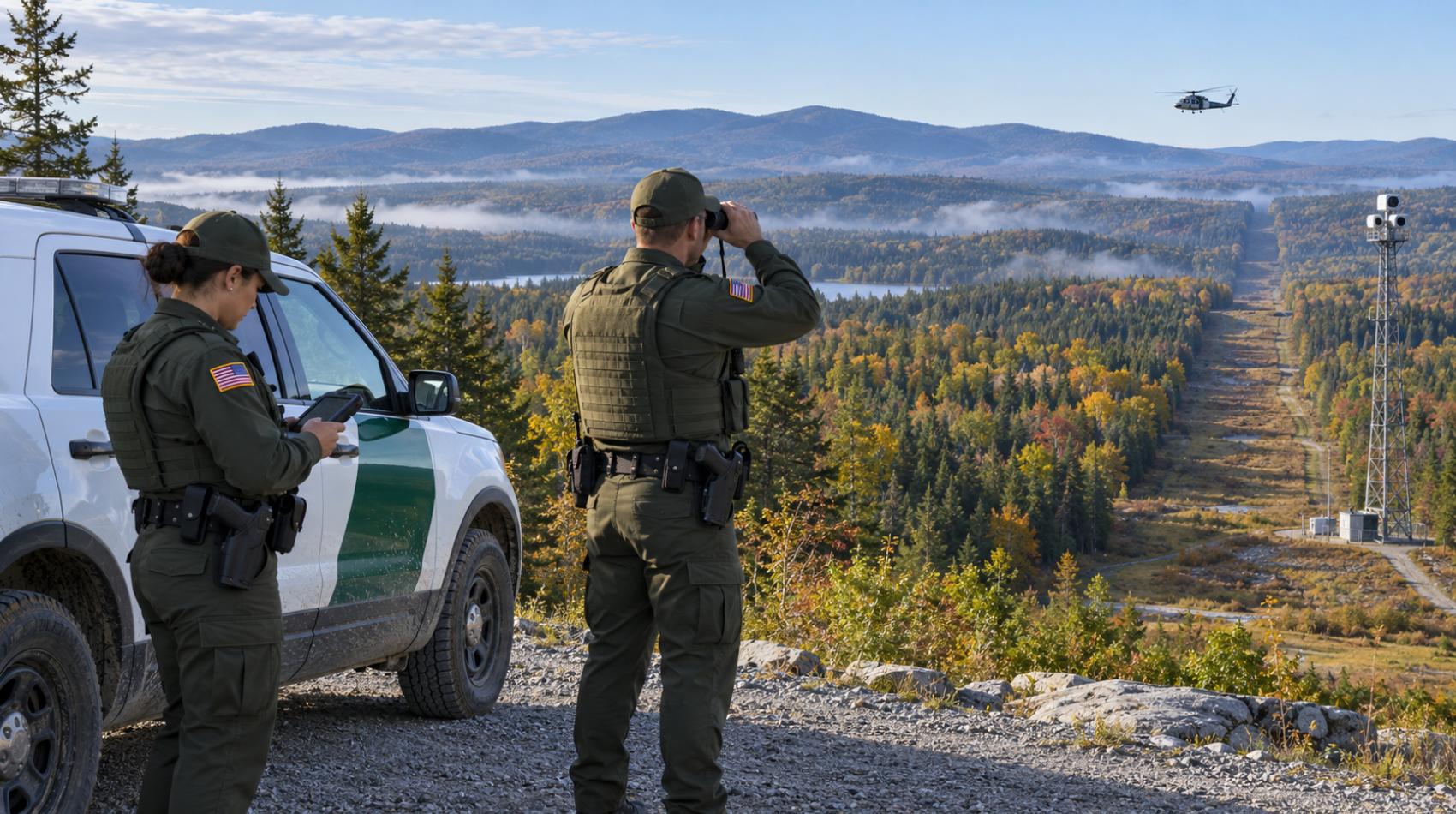
- An Aerial Intelligence Task Force using helicopters, drones and mobile surveillance towers.
- Procurement of 60 drones for integrated border-enforcement missions.
- More than 40 additional secure drones provided by the Canadian Armed Forces.
- Three chartered Black Hawk helicopters supporting patrol, detection and response.
- Repositioning of officers toward areas historically associated with irregular migration.
The RCMP states that these capabilities address threats moving in both directions across the border. Its Border Integrity Operations Centre supports surveillance between official crossings. Royal Canadian Mounted Police
For security professionals, the operational lesson is straightforward: detection equipment has value when it helps officers assess an event and respond in time.
This broader use of technology complements the themes explored in HLS.Today’s reporting on DHS technologies for combating fentanyl, although drug interdiction and migrant-smuggling investigations remain distinct missions.
Canadian asylum rules have also tightened
Canada’s Strengthening Canada’s Immigration System and Borders Act received royal assent on March 26, 2026.
According to IRCC’s official explanation, the legislation introduced additional restrictions on referral of asylum claims to the Immigration and Refugee Board. These include claims made more than one year after a person’s first entry after June 24, 2020, and claims made after 14 days by people who entered irregularly from the United States between ports of entry.
The government also retained pre-removal risk-assessment safeguards for people affected by the new rules.
Separately, the Safe Third Country Agreement continues to govern relevant claims made at the land border or within 14 days of irregular entry, subject to exceptions and exemptions. Canada.ca
These measures primarily concern access to Canada’s protection system. They should not be described as evidence that every claimant is a security threat, or as a complete explanation for changes in southbound crossings.
The remaining weakness: staffing behind the technology
Additional surveillance does not eliminate the need for trained personnel.
GAO’s February 2026 report identified staffing gaps among Law Enforcement Information Systems Specialists—the personnel who monitor surveillance systems and help support operational awareness.
DHS agreed with GAO’s recommendation to develop a workforce plan. In a subsequent update, GAO reported that DHS was considering recruitment and retention incentives. As of August 2026, GAO had not received additional supporting documentation, and the recommendation remained open, with planned actions estimated for completion in January 2027. U.S. GAO
This is an important qualification when assessing enforcement announcements. Purchasing sensors and cameras is one step; ensuring that information is monitored, assessed and acted upon is another.
Congress is seeking more regular threat assessments
A September 15, 2026, House committee report on the proposed Northern Border Security Enhancement and Review Act highlights the need for recurring analysis.
The proposal would require northern-border threat assessments every two years, corresponding strategy updates and performance measures for CBP Air and Marine Operations.
The committee identified organized smuggling, unmanned-aircraft activity and other security concerns as reasons for more consistent oversight. These provisions are described here as legislative proposals, rather than completed operational improvements. govinfo.gov
Regular assessments could help policymakers distinguish a temporary increase in one area from a broader change requiring additional resources.
How serious is the current threat?
HLS.Today’s assessment of the reviewed evidence is that the northern border presents a continuing organized-smuggling and surveillance challenge, while the available figures do not establish a new mass influx driven by Canadian asylum claims.
Three distinctions matter.
First, apprehensions measure detected enforcement events. They cannot, on their own, establish the total number of successful undetected entries.
Second, the latest verified figures cover different periods. Canadian asylum data reviewed here extend through August 2026; GAO’s U.S. trend assessment extends through April 2026. The October prosecution provides newer evidence of enforcement activity, but it does not supply an October crossing total. A complete fiscal-year 2026 northern-border total was not independently verified for this article.
Third, asylum status and criminal involvement require separate evidence. Investigations can establish that particular people participated in smuggling or misused immigration procedures. National asylum totals cannot establish those conclusions for everyone seeking protection.
The most useful indicators to watch next are comparable monthly crossing figures, smuggling-network disruptions, staffing improvements and measurable response performance. Together, those indicators will show whether expanded enforcement is producing durable improvements across America’s northern gateway.
Follow HLS.Today’s Homeland Security and Border Security sections for related coverage.
Official sources
- DOJ: Northern-border smuggling organizer sentenced — October 15, 2026
- DOJ: New York woman pleads guilty to smuggling from Canada — August 11, 2026
- IRCC: Asylum statistics through August 2026
- IRCC: Historical asylum-system overview
- GAO: Northern-border security testimony — June 30, 2026
- GAO: Northern-border resources and staffing, including implementation updates
- RCMP: Border-security initiatives
- Government of Canada: Border-security actions taken
- IRCC: Immigration and asylum changes under Bill C-12
- U.S. House committee report: Northern Border Security Enhancement and Review Act