

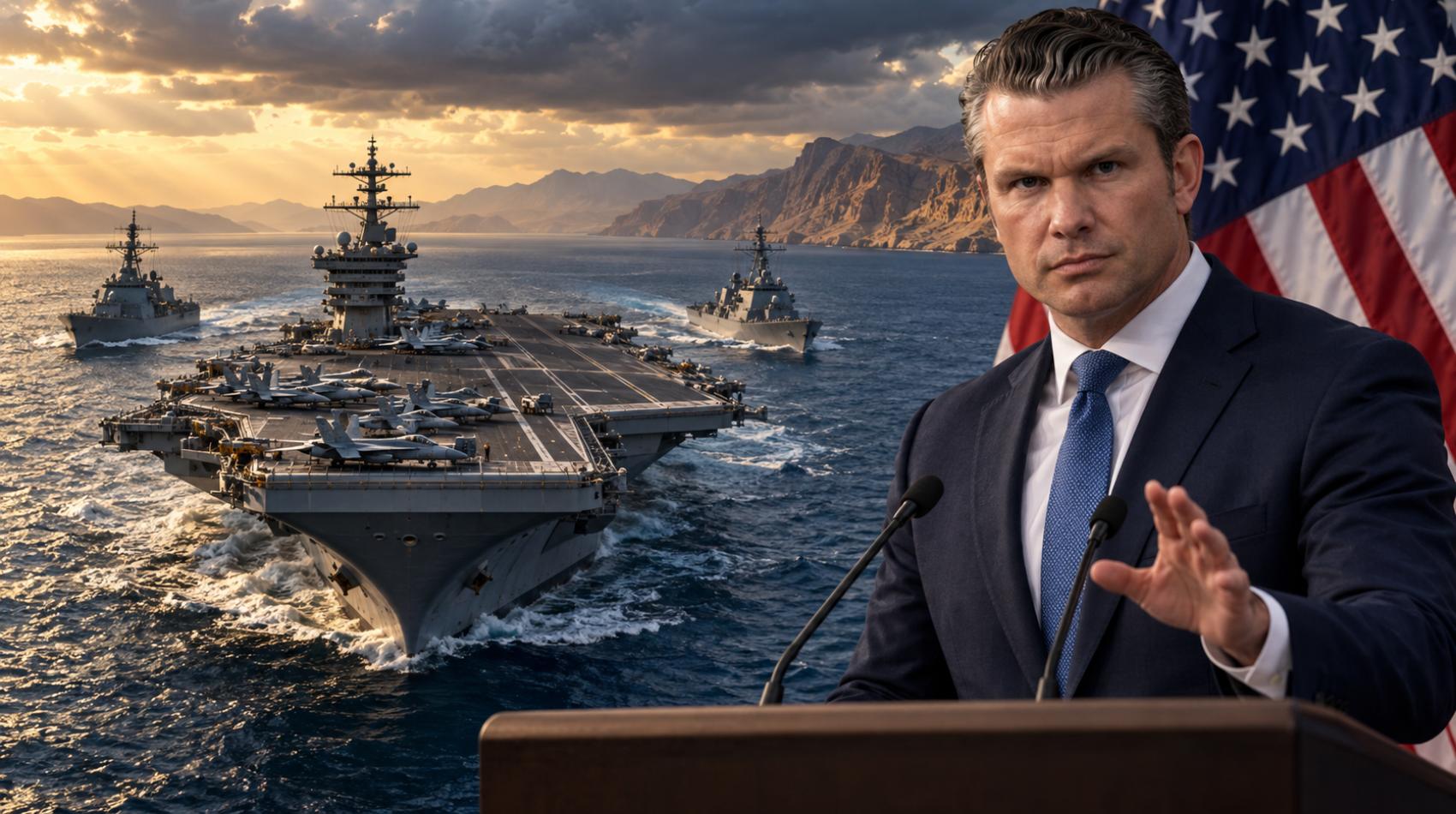
Hormuz on Edge – With two U.S. carrier groups reported in the Arabian Sea, renewed attacks on commercial shipping and fresh warnings from Washington, the confrontation with Iran remains dangerous even as American commanders report progress in protecting maritime traffic.
HLS.Today | November 2, 2026
President Donald Trump’s latest warning about remaining Iranian nuclear targets has sharpened attention on American military power in the Middle East. But the immediate security challenge extends beyond potential airstrikes: commercial ships continue to face attacks around the Strait of Hormuz.
The available evidence presents two developments unfolding together. U.S. Central Command reports successful shipping movements and cleared primary transit routes. Meanwhile, late-October maritime incidents demonstrate that vessels remain exposed to explosives, projectiles and disruption.
For readers following HLS.Today’s homeland security coverage, the distinction matters. The ability to strike Iranian facilities and the ability to protect commercial shipping are related missions, but success in one does not automatically resolve the other.
What Trump Actually Said About Remaining Targets
Speaking to reporters in Florida on October 31, Trump said American forces still had “one or two sites” to address and suggested action could be completed in “10 minutes.”
His remarks concerned Iranian nuclear facilities. They should not be interpreted as an assessment that Iran has only a handful of military targets left or that its maritime attack capabilities have disappeared.
Secretary of State Marco Rubio also indicated on October 31 that diplomacy remained an option. The statements reviewed for this article do not establish that a new attack had been ordered or announce an operational timetable.
The practical distinction is important: a president’s statement about the speed of a possible strike says little about the duration of any subsequent confrontation, the response from Tehran or the consequences for commercial shipping.
U.S. Military Assets: What the Public Record Shows
The clearest recent public fleet snapshot reviewed for this article is the U.S. Naval Institute’s October 26 tracker, updated October 28. USNI is an independent naval publication, not a government command bulletin, and its reporting should be treated as a dated overview.
It reported the following broad regional presence:
| Publicly reported formation | Broad area in the October 26 report | Significance |
|---|---|---|
| USS George Washington and its embarked air wing | Arabian Sea | Carrier-based aviation supporting regional operations |
| USS George H.W. Bush Carrier Strike Group | Arabian Sea | An additional carrier aviation formation |
| USS Boxer Amphibious Ready Group, with the 11th Marine Expeditionary Unit | Arabian Sea | Amphibious and expeditionary capability |
| Additional cruisers and destroyers | Regional waters, including the Red Sea | Surface combatant presence supporting the wider operation |
These deployments demonstrate substantial available naval capacity. They do not, by themselves, prove that Washington has decided to launch another strike or conduct a ground operation.
A reliable article must also acknowledge what is missing. The sources reviewed do not provide a complete, current inventory of regional aircraft, submarines, air-defense batteries, weapons stocks or forces available for immediate employment.
Adding older deployment announcements together would risk counting units that have rotated out or changed missions.
The Latest Maritime Attacks: What Is Confirmed and What Remains Disputed
The most consequential recent developments involve commercial shipping.
Reuters reported on October 30 that a tanker had suffered an attack the previous day near Oman. Maritime security sources assessed that attached explosive devices caused an engine-room fire and temporarily disabled the vessel.
According to the UK Maritime Trade Operations information cited in that report, the crew was safe, the fire had been extinguished, no environmental impact was reported and the vessel was continuing toward its next port. Responsibility for the attack was not immediately established.
Separately, Iran’s Revolutionary Guards Navy claimed on October 30 that four tankers had experienced fires or explosions in the Strait of Hormuz. Reuters said it could not immediately verify those claims.
UKMTO also reported projectile incidents involving commercial vessels. These reports should not simply be added to Iran’s claimed total: without matching vessels, times and incident records, some accounts could describe overlapping events.
A further dispute concerned an American unmanned vessel. Iran claimed it had destroyed one; CENTCOM denied that account and said its unmanned surface vessels were accounted for. That denial also publicly acknowledged American unmanned maritime patrol activity in the strait.
For an accurate assessment, reported commercial damage, Iranian claims and American rebuttals must remain distinct.
CENTCOM Reports Progress in Keeping Shipping Moving
In its October 25 release, CENTCOM said American forces had supported the successful passage of more than 3,000 commercial vessels over six months and assisted Gulf partners in exporting more than 1.5 billion barrels of crude oil since summer.
During a visit to the strait, CENTCOM commander Adm. Brad Cooper stated:
“We continue to stand shoulder to shoulder with our Gulf partners and the shipping industry.”
The command also reported that more than 95 percent of vessels navigating the strait in recent months had passed safely. These are official military figures; the material reviewed does not provide an independent audit of their methodology.
In a video update reported on October 30, Cooper described seeing commercial vessels and American assets during his earlier visit, while saying he had not observed an IRGC presence. That observation should not be expanded into a conclusion that Iranian forces lack the ability to operate or attack elsewhere in the area.
Keeping commerce moving is a meaningful operational result. But a high proportion of successful transits can coexist with serious danger to individual ships.
Why Cleared Shipping Lanes Do Not Mean the Threat Has Ended
Mine clearance addresses a particular hazard at a particular time. It cannot, on its own, eliminate subsequent attacks or every other threat to navigation.
The U.S. Maritime Administration’s Advisory 2026-011 states:
“Numerous hazards to navigation and risks of Iranian attacks against commercial shipping remain high in these areas.”
The advisory identifies threats involving missiles, armed aerial drones and unmanned surface vessels. It also warns of significant satellite-navigation interference, spoofing and jamming.
This explains why reports of cleared routes and reports of new attacks are not necessarily contradictory. A navigable shipping lane can still be exposed to weapons launched from outside it, interference with navigation or renewed hostile activity.
The resulting security mission requires continuing surveillance, coordination with merchant shipping and responses to changing threats not merely a one-time clearance operation.
What Pete Hegseth Has Said
One of the more recent substantive statements located during this review came from Pete Hegseth’s October 17 appearance at the University of Tennessee, where he addressed ROTC cadets and military recruits.
According to Anadolu’s reporting, Hegseth warned that Iran faced a choice between negotiating over its nuclear ambitions and:
“the kind of devastation that America can bring and will bring swiftly if necessary”
He also linked Iran’s conventional missile arsenal and support for regional armed groups to Washington’s broader security concerns. These remarks were delivered on October 17; they should not be presented as a new November 2 announcement.
His message reflects an effort to combine military pressure with a demand for negotiations. It is a statement of policy and intent, rather than independent evidence of the outcome of earlier strikes.
What Washington Has Officially Disclosed About Previous Responses
An important primary source is Trump’s September 3 notification to Congress, available through the U.S. Government Publishing Office.
The letter states that American forces conducted strikes beginning September 1 in response to Iranian attacks in late August. It describes action against maritime attack capabilities, minelaying assets, radar and air-defense systems, and command-and-control facilities.
It also states:
“United States ground forces were not involved in these strikes.”
The administration described those operations as limited and defensive, while saying U.S. forces remained prepared for further action. That is the administration’s stated justification, rather than an independent legal assessment.
This document provides a confirmed historical example of American military responses. It should not be mistaken for confirmation of a new response to the October 29–30 shipping incidents.
The Homeland Security Implications
The confrontation connects overseas military operations with the resilience of civilian trade and infrastructure.
For shipping companies, the immediate concerns include crew protection, reliable navigation, communication with maritime authorities and the ability to respond to an incident. For businesses dependent on Gulf cargoes, the planning challenge is uncertainty: ships may continue moving while individual voyages face disruption.
MARAD advises U.S.-flagged operators to coordinate voyage planning with Naval Forces Central Command’s shipping guidance service, conduct risk assessments and monitor official reporting. Its warning about navigation interference also underscores the importance of checking electronic positioning against other navigation methods.
The information environment requires similar discipline. A claim that a warship has been destroyed, a shipping lane closed or a nuclear capability eliminated can influence public perceptions before supporting evidence emerges. This makes source verification central to HLS.Today’s intelligence coverage and wider security reporting.
What Would Signal a Material Change?
The strongest indicators of a changed situation would be:
- An official announcement of new military action, with a clear date and description of its purpose.
- Updated maritime advisories identifying changes in commercial navigation risk.
- Corroborated incident reports establishing vessel damage, casualties and responsibility.
- New dated deployment announcements, rather than recycled photographs or older fleet lists.
- A documented diplomatic development that changes the conditions for shipping or military operations.
As of this review, the public evidence supports a substantial American regional military presence, continuing efforts to protect commercial passage and a persistent maritime threat. Trump’s warning raises the prospect of further action, but the sources reviewed do not establish a new strike timetable.
For crews and operators navigating Hormuz, the immediate question remains whether sustained protection can reduce attacks while keeping commerce moving.
Sources
Official government material
- U.S. Maritime Administration: Advisory 2026-011—Persian Gulf, Strait of Hormuz and Gulf of Oman
- U.S. Government Publishing Office: President Trump’s September 3, 2026 notification to Congress
- CENTCOM: Commander visits Strait of Hormuz, October 25 — accessible reproduction of the release
- UK Maritime Trade Operations
Supporting reporting
- USNI News: Fleet and Marine Tracker, October 26, 2026
- Reuters: Tanker hit by limpet mines, October 30
- Reuters: Iranian tanker claims and U.S. response, October 30
- Anadolu: Hegseth’s October 17 remarks
- RFE/RL: Trump’s October 31 warning and diplomatic developments
- VOA: CENTCOM commander’s October 30 update