President Trump’s promise of a 1% commission puts citizen investigations in the national spotlight. Behind the headline, a new Justice Department program offers earlier payments for actionable fraud tips—with important eligibility conditions.
HLS.Today | October 21, 2026 – Generated Caption image Illustration
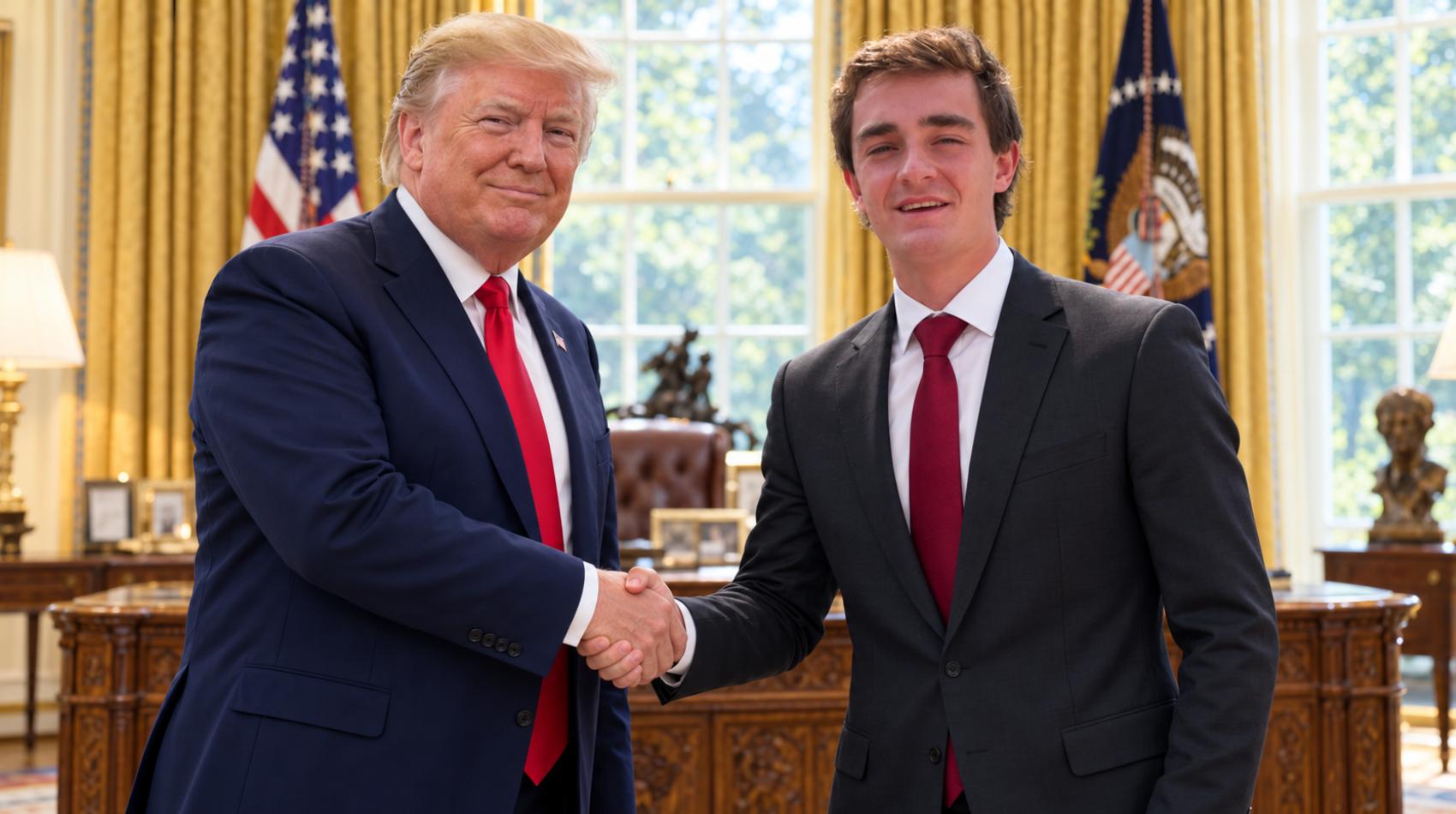
A camera, public spending records, and questions asked outside government-funded businesses helped turn Nick Shirley into a nationally recognized online personality. On October 20, the conservative video creator stood in the Oval Office as President Donald Trump and Vice President JD Vance promoted a new incentive for Americans to report suspected fraud.
The administration’s message was straightforward: people who help protect taxpayer money should have an opportunity to share in the rewards.
The Justice Department’s official announcement establishes the Fraud Whistleblower Incentive Program, or WHIP, backed by a $25 million Treasury commitment. It offers payments of $10,000–$30,000 for qualifying information leading to criminal charges in covered areas. United States Department of Justice
Trump went further in his remarks, describing a 1% commission. Understanding the relationship between that statement and the published rules is essential for anyone considering submitting a tip.
What Trump Said in the Oval Office
During the October 20 announcement, Trump described a percentage-based incentive:
“we are giving a commission to that person of 1 percent.”
He also said he would resolve competing claims over who deserved a reward:
“I will be the arbitrator of all of these decisions.”
These statements appear in the October 20 remarks transcript and contemporaneous reporting. Roll Call
The percentage naturally attracts attention. As simple arithmetic, 1% of $1 million is $10,000; 1% of $100 million is $1 million. Those examples illustrate the scale of the proposal—not an assurance that an applicant qualifies for either amount.
Shirley framed the effort as protecting people who depend on public assistance:
“When you expose fraud, you help save America.”
The White House also announced a $10,000 award for Shirley. Associated Press reported that no check was handed to him in journalists’ presence, so the announcement should be distinguished from independently verified payment. apnews.com
Who Is Nick Shirley—and How Did He Become Famous?
Shirley’s career began with online entertainment rather than formal financial investigations.
A February 2026 profile by The New York Times, republished by The Salt Lake Tribune, describes a Utah upbringing and early YouTube videos built around pranks, stunts, and personal experiences. He subsequently spent two years on a religious mission in Santiago, Chile.
After returning in late 2023, he shifted toward political street reporting and presented himself as an independent journalist. His videos took viewers to politically charged locations and used direct encounters with strangers to tell stories about immigration, public spending, and government performance. sltrib.com
His breakthrough on fraud came with a December 2025 Minnesota video. The appeal was easy to understand: show viewers a business address, describe public money associated with it, and ask whether the visible activity matched what taxpayers might expect.
That approach made a complicated subject accessible. It also created a significant evidentiary challenge: what a camera records during one visit does not, by itself, establish what services a business provides or how it bills a government program.
Minnesota: The Video That Brought National Attention
In written testimony to the House Judiciary Committee, Shirley described receiving tips from Minnesota residents and later working with a local researcher named David.
According to his account, they visited locations on December 16, 2025, using information about enrollment and public funding. Shirley said his resulting video received more than 100 million views across platforms. That audience figure is his reported total, not an independently audited measurement. judiciary.house.gov
The combination of local tips, spending information, and on-camera visits gave the story a powerful visual structure. His work subsequently reached Congress: the House Judiciary Committee’s January 21 hearing listed him as a witness on misuse of public funds. judiciary.house.gov
However, several early allegations were disputed. Inspectors reported that centers were operating as expected. Those findings matter, just as later criminal cases matter: neither should be omitted to create a simpler narrative. apnews.com
What Was Subsequently Proven?
There is a documented criminal development involving a business featured in Shirley’s coverage.
On July 9, 2026, Fahima Egeh Mahamud, formerly associated with Future Leaders Early Learning Center, pleaded guilty to wire fraud and conspiracy to defraud the United States, according to local court reporting. Prosecutors described more than $4.6 million in fraudulent childcare-assistance claims and approximately $850,000 connected to the federal nutrition program. FOX 9 Minneapolis-St. Paul
DOJ’s official Minnesota case summary separately documents the charges and identifies two schemes involving approximately $5.48 million in federal funds. Case Summaries
This is evidence of wrongdoing in a specific case. It does not establish that every business featured in a video committed fraud, or that every interpretation offered in the reporting was correct.
The chronology also deserves attention. Minnesota’s broader federal fraud investigations did not begin with Shirley: DOJ announced charges against 47 defendants in the Feeding Our Future investigation in September 2022. justice.gov
Shirley’s contribution is most accurately described as bringing additional public attention and pressure to suspected abuses. Establishing criminal liability remained the work of investigators, prosecutors, and courts.
Beyond Minnesota: California and New York
Shirley expanded his reporting to other states.
His July 15, 2026 Senate testimony described investigations into California daycare and hospice services and New York City adult-daycare operations. He alleged irregularities involving public payments and, in New York, participant kickbacks. These were his allegations to lawmakers—not findings established merely by their appearance in a congressional document. hsgac.senate.gov
Reporting by WIRED also described Shirley’s use of publicly released Medicaid spending data in selecting California businesses to examine. wired.com
This illustrates the broader development behind his rise: public datasets can help small reporting teams identify patterns that merit investigation.
But unusually high payments, an unexpected address, or a quiet building should be treated as leads. A substantiated fraud case usually requires additional evidence—such as false claims, fabricated records, financial transactions, admissions, or proof that billed services were not delivered.
What the New Reward Program Actually Offers
DOJ’s detailed guidance calls the mechanism the National Fraud Enforcement Division Criminal Tip Rewards Pilot Program. Its initial term is three years.
The principal innovation is timing: a qualifying tipster may receive an award before the prosecution reaches a final judgment or completes appeals. DOJ retains discretion over whether to pay. Eligibility for an early award does not necessarily prevent a later award under a separate government whistleblower program. justice.gov
| Question | What the published materials establish |
|---|---|
| Who administers it? | DOJ’s National Fraud Enforcement Division. |
| How much funding was announced? | A $25 million commitment from Treasury. |
| What is the early payment range? | $10,000–$30,000 for qualifying information. |
| When can payment occur? | At the charging stage; DOJ’s FAQ specifies after criminal charges are unsealed. |
| Must the government recover money first? | The early-stage payment is not dependent on a large recovery or forfeiture. |
| Is payment automatic? | No. Awards remain discretionary. |
| Is an uncapped 1% payment established in these rules? | The reviewed guidance does not set out such a formula. |
Sources: DOJ launch announcement, program guidance, and FAQs. United States Department of Justice
How the 1% Promise Differs From the Written Rules
As of October 21, the documents reviewed do not explain how Trump’s percentage announcement would be calculated or implemented.
Questions remain about whether it would apply to losses identified, money actually recovered, or another measure; whether there would be a cap; and how it would interact with the early-stage award.
Likewise, Trump’s statement about personally arbitrating competing claims is not explained as a procedure in the reviewed DOJ rules. Those rules assign award decisions to the department.
The accurate description is that Trump announced a 1% incentive, while DOJ published a defined early-payment pilot. The relationship between the two needs further written clarification.
That distinction protects the program’s credibility. A person deciding whether to report misconduct should be able to distinguish a public promise from the conditions governing an application.
Which Types of Fraud Are Covered?
The DOJ program overview covers federal healthcare offenses and specified fraud involving government programs and benefits.
The launch announcement identifies programs administered by Agriculture, Labor, Health and Human Services, Housing and Urban Development, Education, Veterans Affairs, the Department of War, and the Small Business Administration. It emphasizes hospice, home healthcare, daycare, and special-services fraud. United States Department of Justice
This is a targeted program rather than a promise to pay for every allegation of waste or every disagreement over spending.
A costly policy, an administrative error, an improper payment, and deliberate criminal fraud are different things. Effective oversight requires determining which occurred.
Who Can Qualify—and What Makes a Useful Tip?
DOJ’s eligibility overview requires an individual to provide voluntary, original, truthful, complete written information, cooperate fully, and supply information leading to covered criminal charges. Corporations do not qualify as individual tipsters. Whistleblower Rewards Program
The detailed guidance excludes various categories, including certain DOJ and law-enforcement personnel and related individuals, foreign officials, and people who meaningfully participated in the wrongdoing. It also addresses false submissions and other disqualifying conduct. Readers should consult the complete rules before assuming eligibility. justice.gov
The FAQ adds several practical distinctions:
- Independent analysis can qualify; merely repeating a news story generally does not.
- Identical later submissions may fail the originality requirement.
- A reward relates to a distinct tip, not automatically to every defendant.
- Confidentiality has legal and procedural exceptions; anonymity is not unconditional. FAQs
A useful submission should explain what happened, who was involved, which program paid, when the conduct occurred, and how the reporter knows. Records connecting a payment to a false representation are more useful than an unsupported accusation.
Where Should People Report?
DOJ directs applicants to the official America.gov fraud portal. Its FAQ strongly encourages that channel and says submissions through other routes may be denied an award.
A social-media post is therefore not a substitute for submitting information through the designated process. FAQs
For reporting purposes, preserving original records and clearly separating direct observations from assumptions helps investigators assess a lead. Citizen reporting can support enforcement without requiring confrontation, unauthorized access, or public accusations against people whose conduct has not been established.
How This Fits With Existing Whistleblower Programs
Financial rewards for exposing government fraud are not new.
The False Claims Act, originally enacted in 1863, allows private individuals to bring certain civil cases on behalf of the United States and potentially receive part of the recovery. That is a different process from submitting a criminal tip under this pilot. The False Claims Act
DOJ also operates a separate Corporate Whistleblower Awards Pilot Program, which concerns qualifying original information leading to successful forfeiture. Whistleblower Awards Pilot Program
The new initiative’s distinguishing feature is the prospect of an earlier, defined payment. It should be evaluated as an additional reporting mechanism, not as the first opportunity Americans have ever had to receive a whistleblower reward.
Why the Initiative Matters for Homeland Security
Fraud diverts resources from legitimate recipients and can weaken confidence in essential programs. Protecting those resources belongs within the broader homeland security mission covered by HLS.Today.
The administration’s approach links public reporting to the Task Force to Eliminate Fraud, established in March under Vance’s leadership. Its responsibilities include coordination across agencies, stronger payment controls, and action against fraud networks. The White House
The constructive opportunity is clear: encourage people with useful information to come forward earlier, then equip investigators to verify it.
Shirley’s rise demonstrates how accessible video reporting can draw national attention to public spending. It also demonstrates why attention and proof must remain distinct.
The new program will ultimately be judged by the quality of its leads, the fairness of its decisions, the fraud it prevents, and the money it protects. Clear written rules—including clarification of the 1% promise—will help turn public enthusiasm into dependable accountability.