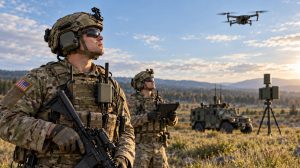


SI Takes Center Stage – From stronger cyber defenses to domestic computing centers, the federal push for Super Intelligence raises a defining homeland security question: can America build, power, and protect the capacity it needs—when it needs it?
HLS.Today | Analysis | October 19, 2026 – Featured Image: President Trump and Jacob Helberg at SI center illustration.
Super Intelligence, or SI, is entering the vocabulary of the United States government. For homeland security professionals, the significance reaches beyond a new name: it brings renewed attention to the computing systems, trusted data, energy supplies, and human expertise that increasingly support national resilience.
The CISA Super Intelligence topic page and DHS’s Super Intelligence at DHS resources sit within a broader federal effort involving cybersecurity, scientific research, infrastructure development, and national security.
There is an essential distinction at the outset. The new terminology does not demonstrate that DHS has created a machine with intelligence surpassing humans across all fields. Nor do the materials reviewed announce a single DHS-controlled network of “SI factories.”
What they reveal is a combination of an official naming change, established technology programs, newer security guidance, and substantial initiatives to expand American computing infrastructure. Together, these developments offer a consequential opportunity to strengthen homeland security. whitehouse.gov
1. What “Super Intelligence” Actually Means in Federal Policy
On September 29, 2026, President Donald Trump issued Executive Order 14434, “Inaugurating the Era of Super Intelligence”.
The order directs executive agencies to adopt “Super Intelligence” and “SI” in place of “Artificial Intelligence” and “AI” in specified official communications and non-statutory documents, to the extent permitted by law.
Crucially, its operative definition initially covers the technologies already encompassed by the existing federal statutory definition of artificial intelligence. It also requests proposed legislative language within 60 days. Previously issued historical documents need not be altered. whitehouse.gov
That makes SI an official policy label, rather than a certification that a particular system has reached a new scientific threshold. A narrowly focused detection model and an advanced generative system may both appear within this terminology.
For readers and procurement teams, capabilities must still be evaluated individually: what does a system do, how reliably does it perform, and what authority does it have?
2. DHS’s Starting Point: Real Missions and Existing Experience
DHS’s use of these technologies predates the September announcement. HLS.Today’s earlier reporting on the creation of the DHS AI Task Force provides historical context for the department’s continuing work.
The current DHS SI Use Case Inventory organizes publicly disclosable applications by component. It explains their purpose and identifies whether they are considered high-impact.
The inventory is not a complete picture of every sensitive government activity: DHS explicitly identifies exclusions, including certain intelligence and national-security uses. Homeland Security
This is useful transparency. Readers can look beyond a broad technology announcement and examine specific missions, deployment status, and oversight arrangements. They should also distinguish a proposed or developing application from a system already operating in production.
The practical opportunity is substantial: help personnel process information faster while keeping responsibility for consequential decisions clearly assigned.
3. CISA’s Dual Mission: Use Intelligent Tools and Protect Them
CISA’s role spans two connected tasks: applying intelligent tools to cyber defense and helping organizations secure the intelligent systems they adopt.
Its archived December 2024 use-case explanation describes applications including network anomaly detection, threat-indicator scoring, identification of potentially sensitive personal information, and assistance with malware analysis.
That page is historical, so its counts and development stages should not be presented as a current 2026 inventory. Nevertheless, it illustrates the operational direction: help analysts find relevant signals in large volumes of information. cisa.gov
Consider a security operations center receiving thousands of alerts. The useful measure is whether analysts can identify a genuine intrusion sooner, investigate it accurately, and act before services are disrupted.
This is the security context explored in HLS.Today’s reporting on China-linked cyber enablers targeting critical infrastructure. More analytical capacity can help defenders, but its value depends on trustworthy data and effective response procedures.
4. The Guidance Behind the Headline
Several official publications turn the broad SI ambition into practical security work.
Protecting operational technology
CISA and international partners’ guidance on integrating intelligence systems into operational technology addresses environments where software interacts with physical processes.
The accompanying guidance identifies four priorities: understand the technology and its risks; assess its suitability for the operational environment; establish governance and assurance; and incorporate safety and security into deployment. CISA
For a utility or industrial operator, this means judging an application against its actual operating conditions. A tool that helps interpret maintenance records presents a different risk from one authorized to influence machinery.
Controlling agentic systems
The May 2026 Careful Adoption of Agentic SI Services publication addresses systems capable of carrying out tasks through connected tools. CISA
The practical implication is that access permissions deserve as much attention as answer quality. An assistant that summarizes an incident and an agent that changes network settings require different controls.
A sensible deployment design limits privileges, records actions, and requires approval for consequential changes. These are implementation considerations, rather than evidence that every agency has already deployed such safeguards.
Knowing what is inside the system
CISA’s Software Bill of Materials for SI—Minimum Elements, released with G7 partners in May 2026, promotes greater supply-chain transparency. CISA
An inventory of components helps organizations understand what they depend on and respond when a vulnerability emerges. It supports security decisions; it does not independently prove that a model is accurate or safe.
5. Strategic Independence Means Keeping Essential Services Available
The concern about dependence on other countries is legitimate, but it needs a precise operational definition.
For homeland security, independence means retaining sufficient control over essential capabilities to continue functioning during conflict, disruption, or a commercial dispute. The location of a server is only one part of that problem.
An organization also needs to understand who controls its software updates, administrative access, encryption keys, replacement equipment, and contractual rights to continued service.
The June 2026 National Security Presidential Memorandum NSPM-11 directly addresses continuity and control within the national security enterprise. It calls for resilient supply chains, rigorous assurance, and arrangements to prevent commercial entities or adversaries from disabling, degrading, or materially changing mission-dependent systems without government knowledge and approval. The White House
Its scope should not be confused with a universal rule governing every civilian application. Nevertheless, the operational lesson is widely relevant: critical users need credible alternatives and continuity plans.
HLS.Today’s coverage of cyber threats to defense supply chains highlights why suppliers and subcontractors belong in that assessment.
6. Domestic Strength and Allied Cooperation Can Reinforce Each Other
Reducing exposure to adversarial control does not require treating every overseas supplier or international partnership as an equal risk.
America’s AI Action Plan, released in July 2025, combines domestic infrastructure and semiconductor priorities with cooperation involving allies and partners. It also recommends stronger protections for sensitive technology and evaluation of risks from adversaries’ systems. whitehouse.gov
For an operator, a useful approach is to map dependencies by consequence: which supplier failure would interrupt a critical service, expose sensitive data, or make recovery impossible?
Domestic hosting may reduce some jurisdictional and continuity risks. Multiple trusted suppliers, tested migration procedures, and accessible replacement equipment can address others.
The objective should be resilience that can be demonstrated. A domestic address alone does not establish that a system is secure, and a diversified allied supply chain may provide valuable redundancy.
7. What Would a National “SI Factory” Actually Deliver?
“SI factory” is a useful descriptive term for a facility that brings together computing hardware, data, software, power, and skilled personnel to produce or operate intelligent services. In this article, it is not the name of a verified DHS construction program.
There are also different kinds of demand.
Training capacity supports the creation or adaptation of models. Inference capacity runs those models to answer requests and perform tasks. Evaluation capacity tests whether their outputs and behavior meet operational requirements.
A large training campus does not automatically satisfy a hospital’s, port’s, or agency’s need for a dependable service. The operating model must also address connectivity, data protection, response time, maintenance, and recovery.
As an architectural recommendation, a resilient national system could combine large domestic computing campuses with regional service capacity and smaller local installations for sensitive or time-critical work.
The relevant measure would be dependable capability delivered to users—not merely the number of processors purchased.
8. The Federal Infrastructure Buildout Is Already Taking Shape
The policy basis for expanding domestic capacity extends well beyond DHS.
The July 2025 executive order on accelerating data-center infrastructure permitting addresses computing facilities and the equipment and energy systems supporting them. It promotes faster development and the use of federal land, subject to applicable requirements. The White House
DOE then identified four sites for potential AI data-center and energy development: Idaho National Laboratory, Oak Ridge Reservation, the Paducah Gaseous Diffusion Plant, and Savannah River Site. Department of Energy
Subsequent announcements show the range of activity:
- Portsmouth, Ohio: DOE reported in April 2026 that SB Energy, a SoftBank Group company, had announced a public-private partnership to construct a major AI data center on leased DOE land.
- Paducah, Kentucky: DOE described an August 2026 partnership involving a planned $100 billion redevelopment into a data-center campus and associated energy infrastructure. It projected approximately 8,000 construction jobs and 600 permanent jobs. energy.gov
These are significant development announcements. They should not be read as proof that all planned capacity is already energized or available to DHS.
The Portsmouth example also illustrates an important distinction: infrastructure located in America can involve international capital. Domestic location, corporate ownership, operational control, and government access are separate questions.
Sources: DOE Portsmouth announcement and DOE Paducah update.
9. Genesis Adds a National Scientific Computing Dimension
DOE’s Genesis Mission provides another part of the picture.
Led by DOE and its 17 national laboratories, the initiative aims to connect advanced computing, scientific instruments, intelligent systems, and research datasets. Its stated ambition includes accelerating discovery and strengthening national security. genesis.energy.gov
The White House announced more than $5 billion for Genesis-related efforts in July 2026. That announcement also describes DHS participation in work on early detection and attribution of biological threats. The White House
This establishes a concrete connection between national computing investment and homeland security research. It does not mean Genesis is a general-purpose DHS cloud or that every department can immediately draw on all of its resources.
For security planners, it offers a useful model: shared infrastructure organized around defined problems, with scientific expertise and data access treated as essential components.
10. Electricity and Cooling Determine How Quickly Capacity Arrives
A computing campus cannot deliver useful services simply because land has been allocated or equipment ordered.
Power generation, grid connections, substations, cooling, fiber links, and trained operators must become available together. A delay in any one of these can prevent the rest of the investment from being productive.
The administration’s March 2026 Ratepayer Protection Pledge addresses part of this challenge. The White House says participating companies committed to bringing additional generation resources and covering infrastructure upgrades required by their data centers, with the aim of protecting households from those costs. The White House
This is a constructive policy objective. Its results should be assessed through actual utility agreements, delivered generation, grid reliability, and customer costs.
From a homeland security perspective, computing demand and electricity resilience must be planned together. New capacity should support the communities and essential services around it.
That connection belongs within the wider infrastructure security agenda covered by HLS.Today.
11. Space Data Centers Deserve Research—Today’s Missions Need Deliverable Capacity
Elon Musk’s SpaceX has advanced an ambitious orbital computing proposal.
An FCC public notice released on February 4, 2026 accepted for filing an application for a SpaceX Orbital Data Center system involving up to one million satellites. docs.fcc.gov
Acceptance for filing is a regulatory procedural step. It is not, by itself, an authorization, a deployment milestone, or evidence of available computing service. The official material reviewed does not establish a dependable delivery schedule for capacity that homeland security users could purchase and operate.
Orbital computing would also require careful assessment of launch logistics, communications, heat rejection, radiation exposure, maintenance, and disposal. These are engineering and operational considerations, not a prediction that the concept will fail.
For current planning, the appropriate distinction is between research options and capacity that can meet a specified mission deadline.
DHS, utilities, ports, and emergency services need tested services and recovery arrangements now. Their near-term plans should be based on demonstrably available terrestrial infrastructure, while future space-based options are evaluated on their merits.
12. Build Quickly, Then Prove the Security Benefit
The strongest case for the administration’s approach is the connection it draws between technology adoption, domestic infrastructure, energy, and national security. That is a practical foundation for improving American capacity.
Execution will determine the outcome.
For agencies and critical infrastructure operators, HLS.Today’s assessment is that progress should be judged against a short set of operational questions:
- Does the system detect threats or support decisions more accurately?
- Does it reduce response time without creating an unmanageable volume of false alerts?
- Can essential services continue if a model, vendor, network, or site becomes unavailable?
- Are sensitive data and administrative access protected?
- Can authorized personnel review, correct, and stop consequential automated actions?
- Do measured benefits justify the full cost of computing, power, integration, and maintenance?
These are proposed evaluation criteria, not a claim that every federal program already reports them.
13. The Opportunity: Make SI a Dependable National Capability
The emergence of Super Intelligence in federal policy gives DHS and its partners an opportunity to make intelligent tools more useful, secure, and operationally dependable.
CISA’s guidance offers practical foundations. DOE’s development initiatives address physical capacity. National security policy emphasizes continuity and control. Private industry supplies much of the technology and construction capability.
The next challenge is connecting those elements in ways that produce measurable benefits for the people protecting the country.
For homeland security, the most meaningful achievement will be a capability that works during a crisis: analysts who can identify an attack sooner, infrastructure operators who can maintain services, and agencies that retain control over the systems on which their missions depend.
America’s SI advantage will be built through reliable infrastructure, trusted technology, and people equipped to use both.