

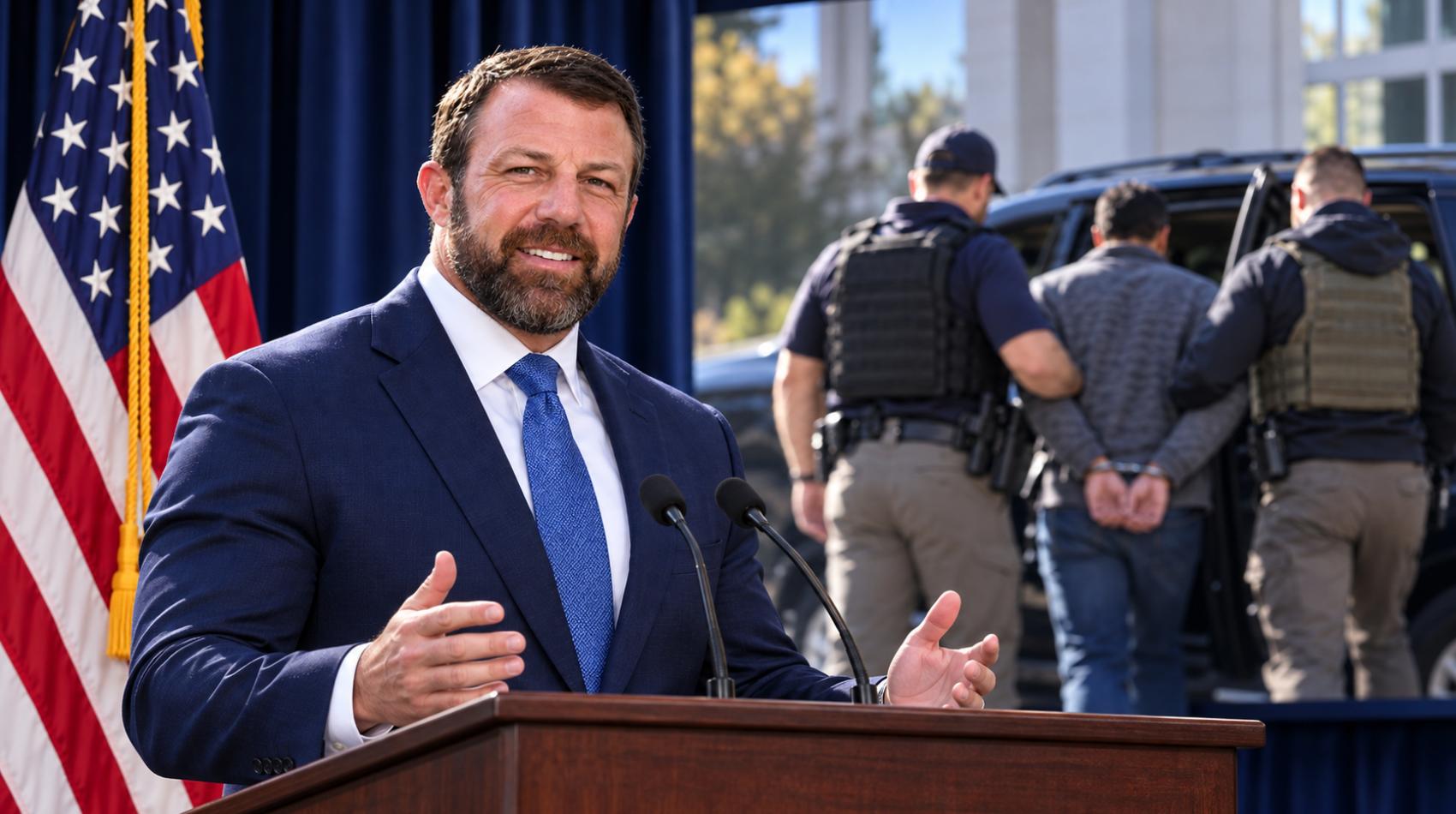
DHS: Federal Fraud Crackdown – New enforcement actions highlight efforts to safeguard elections and taxpayer-funded services, while a reported DHS employee-data leak raises a separate challenge: protecting the people conducting those investigations.
HLS.Today | October 29, 2026 (AI-illustration Markwayne Mullin 9th Secretary of the U.S. Department of Homeland Security)
Federal authorities are pursuing election-related offenses, alleged false health care billing and schemes targeting food-assistance benefits in a series of October enforcement actions.
The announcements illustrate the breadth of work involving the Department of Justice, Homeland Security Investigations and federal and state partners. They also require careful interpretation: arrests are not convictions, alleged losses are not necessarily recovered money, and separate investigations should not be presented as one connected criminal network.
For readers following HLS.Today’s law-enforcement coverage, the central issue is how these operations translate into stronger protection for public institutions and the people who depend on them.
Election Enforcement: What the Official Record Establishes
An independently accessible Justice Department announcement dated October 19 documents 28 people charged and 11 arrested that day in California under Operation Protect the Vote.
DOJ described a coordinated effort involving all four California U.S. Attorney’s Offices. The alleged offenses included false statements in naturalization applications and, for some defendants, fraudulent voter registration. Prosecutors said most of those charged had also cast unlawful ballots.
Importantly, DOJ identified all 28 defendants as lawful permanent residents. Their legal immigration status did not confer U.S. citizenship or eligibility to vote in federal elections. Describing this particular group as people who had all entered or remained in the country unlawfully would misstate the announcement. The charges remain allegations. United States Department of Justice
USAGov’s voting guidance explains that noncitizens, including permanent legal residents, cannot vote in federal elections. Some jurisdictions permit noncitizen participation in specified local elections, making the election involved an important detail. Naturalized U.S. citizens, by contrast, may vote when they meet the applicable eligibility requirements. USAGov
These cases document enforcement against specific alleged violations. The announcements alone do not establish the nationwide prevalence of unlawful voting or demonstrate that it changed an election result. Protecting electoral confidence requires both investigating credible evidence and accurately describing what that evidence proves.
Maine Health Care Case: Alleged Billing for Services Never Delivered
On October 27, the U.S. Attorney’s Office for the District of Maine announced the arrest of six residents following a federal grand jury indictment. Community Home Health Care LLC, a South Portland personal-care agency, was also charged.
Prosecutors allege that the defendants submitted false Electronic Visit Verifications, recording personal-care services that had not actually been provided. The release identifies more than $600,000 in claims associated with one client since 2020; that figure should not be presented as a final court-determined fraud loss.
Two defendants also face obstruction charges, and another faces a false-statements charge.
The investigation involved the FBI, HHS Office of Inspector General, HSI and IRS Criminal Investigation, with assistance from Maine’s Medicaid Fraud Control Unit. DOJ identified it as a Homeland Security Task Force prosecution. All defendants are presumed innocent unless proven guilty. United States Department of Justice
The practical lesson is that an electronic record is only as reliable as the information entered into it. Digital verification can support oversight, but investigators must still determine whether the underlying service occurred.
SNAP Enforcement: Protecting Benefits From Theft and Diversion
The strongest detailed official source for the wider benefits-fraud effort is DOJ’s October 21 nationwide enforcement announcement.
DOJ reported actions against more than 40 defendants, involving 13 U.S. Attorney’s Offices, the Utah Attorney General’s Office and investigative partners. The September 1–October 21 effort covered nearly $45 million in intended losses across SNAP and related USDA programs, including nearly $42 million associated with SNAP.
Those figures describe the enforcement package’s reported loss exposure—not an announcement that $42 million had been recovered.
The cases encompass different conduct, including stolen benefit-account information, fraudulent retail transactions, identity theft and prohibited exchanges of benefits for cash. The package also includes different procedural stages: pending charges, guilty pleas and sentences. HSI’s stated role includes investigating networks using skimming devices, stolen identities and fraudulent retailers. United States Department of Justice
This distinction matters because legitimate beneficiaries can be the direct victims. A family whose food benefits are stolen is harmed alongside the taxpayers financing the program.
Eligibility Rules Require Precision
Enforcement coverage should distinguish fraudulent receipt of benefits from lawful participation by eligible noncitizens.
Current Connecticut government guidance explaining federal SNAP rules identifies qualifying categories that include lawful permanent residents, Cuban or Haitian entrants, and citizens covered by the Compacts of Free Association. Waiting periods and other eligibility conditions can apply.
USDA’s SNAP eligibility guidance also explains that undocumented noncitizens are not eligible, while eligible members of a household may still qualify even when other household members do not. portal.ct.gov
Consequently, nationality or the presence of a noncitizen in a household does not itself establish benefits fraud. Investigations must establish the relevant eligibility, representations and transactions.
The Administration’s Broader Anti-Fraud Strategy
The enforcement actions sit within a wider federal policy initiative.
President Trump’s March 16 executive order establishing the Task Force to Eliminate Fraud placed Vice President JD Vance at its head. Its stated priorities include stronger eligibility verification, controls before funds are disbursed, interagency information sharing and disruption of fraud networks. The White House
These are constructive operational goals: prevention can protect public funds before a lengthy investigation becomes necessary, while coordinated investigations can connect records held by different agencies.
Another measure is the Fraud Whistleblower Incentive Program announced October 20. DOJ says qualifying information leading to covered criminal charges can receive discretionary early awards of $10,000–$30,000, supported by a $25 million Treasury commitment. The department directs potential participants to its published terms and official reporting process. United States Department of Justice
Readers can explore the background in HLS.Today’s report on Nick Shirley and the administration’s fraud-rewards push.
The program’s value will depend on the quality of information received, the fairness of investigations and measurable outcomes—not simply the number of accusations submitted.
A Separate Security Challenge: Reported DHS Employee-Data Exposure
Alongside the enforcement announcements, news organizations reported the publication of records concerning more than 41,000 DHS employees and contractors.
The Washington Post reported that DHS acknowledged a “potential breach” and said it was addressing the situation and working to protect personnel. This is an agency response conveyed through news reporting, rather than a technical incident report published on a government website. washingtonpost.com
WIRED reported that Distributed Denial of Secrets published the material after receiving it from a group calling itself the Department of Peace. The publishers attributed the data to DHS’s Okta login environment. However, Okta told WIRED it had no evidence that its own systems or data had been compromised. The precise intrusion method therefore remains unconfirmed in the sources reviewed. wired.com
The reported exposure should not be described as proof that passwords were stolen, that every listed account was compromised, or that investigators’ case files were accessed.
There is also no established connection in the reviewed sources between the exposure and the specific fraud cases discussed above. It is a separate security incident relevant to HLS.Today’s cybersecurity coverage.
What to Watch Next
The next meaningful developments will be court outcomes, substantiated loss calculations, restitution or forfeiture decisions, and evidence that preventive controls are working.
For the reported DHS data incident, the outstanding questions concern its verified scope, access method, operational impact and remediation. For the enforcement cases, the essential distinction remains between what agencies allege and what the evidence ultimately establishes.
Effective protection of public trust requires both: determined investigation of wrongdoing and accurate, accountable reporting of the results.