
DHS Tests Counter-Drone Systems for State and Local Law Enforcement
DHS field assessments examine whether counter-drone systems can meet the practical demands of state and local policing, from rapid deployment to protecting large public gatherings.
A counter-drone system may offer impressive capabilities, but can officers transport it, set it up and use it effectively when a public event faces an aerial threat?
That question is central to a recent assessment led by the U.S. Department of Homeland Security’s Science and Technology Directorate (S&T). In an October 1, 2026 feature article, DHS describes five days of testing in August that brought federal specialists and law enforcement personnel together to evaluate commercially available counter-unmanned aircraft system (C-UAS) technologies.
The central message is practical: equipment must suit the people using it and the situations they face. Technical performance is only one part of that assessment.
What counter-drone systems actually do
C-UAS is an umbrella term for technologies that help security teams address unauthorized drone activity. Understanding their different functions makes the purpose of the DHS tests clearer.
Detection alerts operators to a possible drone presence. Tracking follows its movement. Identification helps establish what has been detected. Mitigation involves action to counter the drone’s activity, where legally authorized.
These functions are related, but they are not interchangeable. Detecting a drone does not itself stop it, and possession of equipment does not establish authority to use every capability it offers.
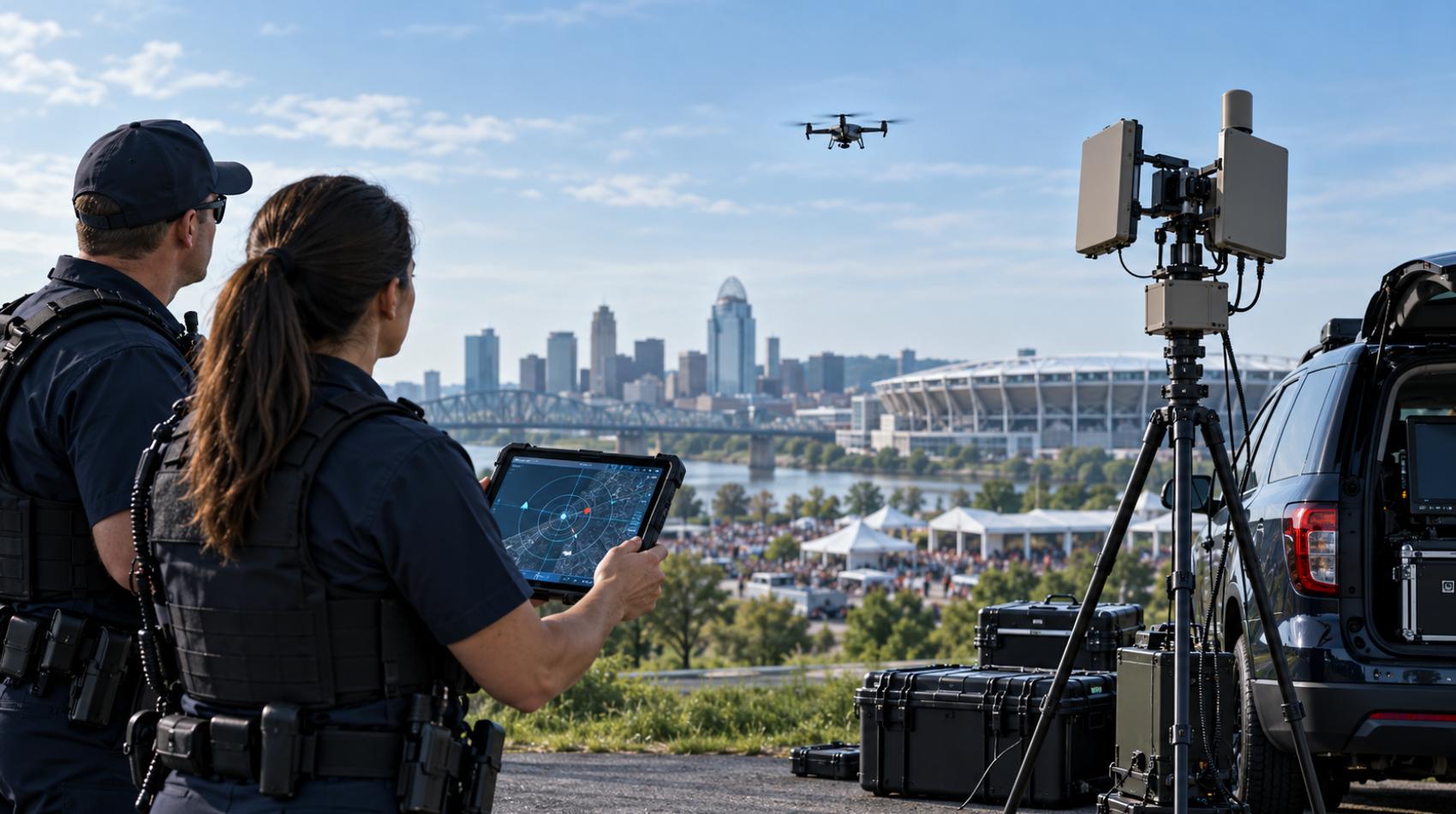
DHS says this assessment focused specifically on mitigation while also placing detection and tracking within operational scenarios. Its account describes radio frequency equipment and real-time radar tracking, but does not publish a detailed comparison of individual systems.
Testing begins before a drone arrives
The assessment was led by S&T’s National Urban Security Technology Laboratory (NUSTL), working with the directorate’s C-UAS research, development, testing and evaluation team.
One scenario began with a credible threat to a public gathering. Responders had to carry equipment to a designated location, move cases up stairs, assemble tripods, mount components and power up the systems.
These tasks may seem basic. For a responding police unit, however, they determine whether a capability can be brought into service in a useful and realistic way.
The exercise examined a question procurement documents can easily understate: how demanding is deployment for the officers who will actually perform it? Weight, portability and setup complexity all affect whether equipment fits an agency’s operations.
The operational lesson is that readiness begins with getting a system into position and working.
Simulating threats to a major event
A second scenario tested the systems during a simulated Special Event Assessment Rating (SEAR) 1 event. With equipment already operating, drones approached as simulated threats, and law enforcement participants used the systems to detect, track and mitigate them.
This moved the evaluation from physical deployment to operational use. It gave participants hands-on experience with the equipment while assessing how its capabilities might support their missions.
Representatives quoted by DHS included personnel from the Los Angeles County Sheriff’s Department and police departments in Atlanta and Houston. Their comments reflected shared concerns about preparing for large gatherings, understanding available equipment and making informed purchasing decisions.
Houston’s representative specifically highlighted advanced detection as a capability likely to assist the department’s mission. That observation underlines an important operational relationship: an effective response depends on first establishing what is happening in the airspace.
Helping agencies make informed purchases
The testing forms part of S&T’s System Assessment and Validation for Emergency Responders (SAVER) program, which provides independent evaluations of commercially available equipment.
For agencies with limited budgets and technical staff, the value is straightforward. Evaluating a crowded technology market takes time, expertise and resources that many departments cannot dedicate to their own trials.
SAVER is intended to help fill that gap through assessment results and explanations of the methods used. DHS emphasizes that the program does not endorse particular products or vendors.
For procurement teams, the useful question is therefore which system fits a defined mission. A department supporting temporary events may place different demands on portability and deployment than an organization protecting a fixed site. That is a practical implication of the assessment’s emphasis on operational suitability, rather than a published finding about a particular product.
Source: DHS.GOV